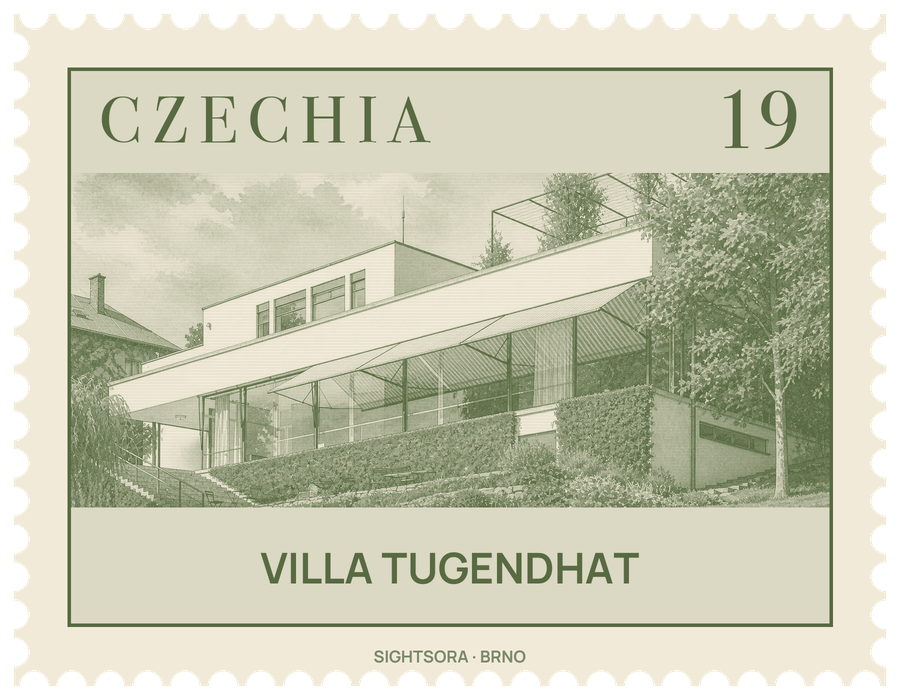
Ludwig Mies van der Rohe designed it, working with Lilly Reich, for Fritz and Greta Tugendhat, and it was completed in 1930. Built of reinforced concrete around an iron frame that made load-bearing walls unnecessary, it became one of the early landmarks of modern architecture in Europe. UNESCO inscribed it as World Heritage in 2001; the villa's managers name the purity of its architecture, the flowing connection between inside and outside, its technical equipment, its fine and exotic materials and, above all, how well it has survived.
The villa stands free on its hillside facing south-west, over three storeys. The street entrance leads in at the top, to the hall and the bedrooms of the parents, the children and the nanny; below lies the great open living floor with a conservatory, a terrace, the kitchen and the servants' rooms; the lowest level held the service rooms. In the main living space a curtain wall of large windows frames a view of Špilberk Castle, and two of the panes can be lowered completely into the floor by a mechanism hidden in the basement. There are no paintings: the decoration comes from the materials themselves, chief among them a brown-gold onyx wall from the Atlas Mountains in Morocco, whose cutting Mies supervised and which turns partly translucent when the evening sun is low, along with rare tropical woods. Mies and Reich designed the furniture too, including the Tugendhat chair and the Brno chair.
The basement reveals how advanced the house was for its day: an air-conditioning system, the machinery that moves the windows, and the Mottenkammer, a room built to keep fur coats safe from moths. The Tugendhats lived here for only eight years. Facing Nazi persecution of the Jewish people, they fled Czechoslovakia with their children in 1938, first to Switzerland and then to Venezuela, and they never came back to live in the house. The Gestapo seized it in 1939, the Messerschmitt aircraft works used it as offices from 1942, and in 1945 Soviet soldiers quartered here damaged it further; much of the furniture disappeared or was burned.
After the war the villa became city property and served various purposes, among them a children's physiotherapy centre. Greta Tugendhat came back in 1967 with Dirk Lohan of Mies's Chicago studio to explain the original design, and in 1969 the building was inscribed as national cultural heritage. Here, on 26 August 1992, the Czechoslovak leaders Mečiar and Klaus met to sign the document that divided Czechoslovakia into the Czech and Slovak Republics. The city of Brno has run the villa as a museum since 1994, and it was thoroughly restored between 2010 and 2012; some of the original wood panelling had turned up at Masaryk University. Nearby stands the Art Nouveau Löw-Beer Villa, where Greta grew up.