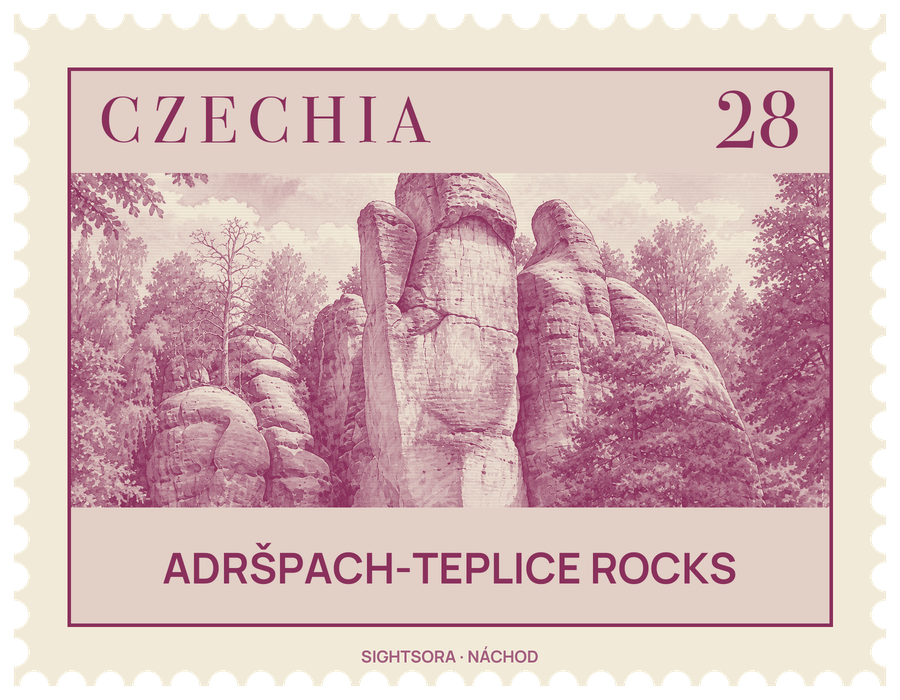
A national nature reserve since 1933, the rocks occupy 17.12 square kilometres, and in 1991 the reserve was taken into the Broumovsko Protected Landscape Area. Marked circuits lead visitors between the towers.
Over the centuries many of the rocks were given fanciful names, among them the Spanish Wall, Grandfather's Chair, the Sugar Loaf, the Mayor, the Lovers and the pair called Rübezahl's Organ and Rübezahl's Toothpick. Walkers can also look for old inscriptions carved into the stone in a variety of languages; together with surviving postcards, they show that the rocks were already a regional excursion in the 19th and early 20th century.
For a long time local people went into the rock city only when they needed a refuge. Late in the 13th century the castles of Střmen and Adersbach were built here, followed later by Bischofstein, now a ruin known in Czech as Skály. Nature lovers from Silesia began coming around 1700, Goethe visited in 1790, and the first paths were laid out at the start of the 19th century to open the rocks up to visitors. In 1824 a fire burned among the rocks for several weeks and destroyed the forest around them.
The towers are a popular climbing area, and they are also a permanent breeding site for peregrine falcons. The birds are protected by national law, and parts of the rock city are closed to climbers and hikers so that they are not disturbed.
Getting there
Adršpach can be reached by car, train, bus or bicycle; the railway station and the bus stop are both a short walk from the entrance to the rock city.