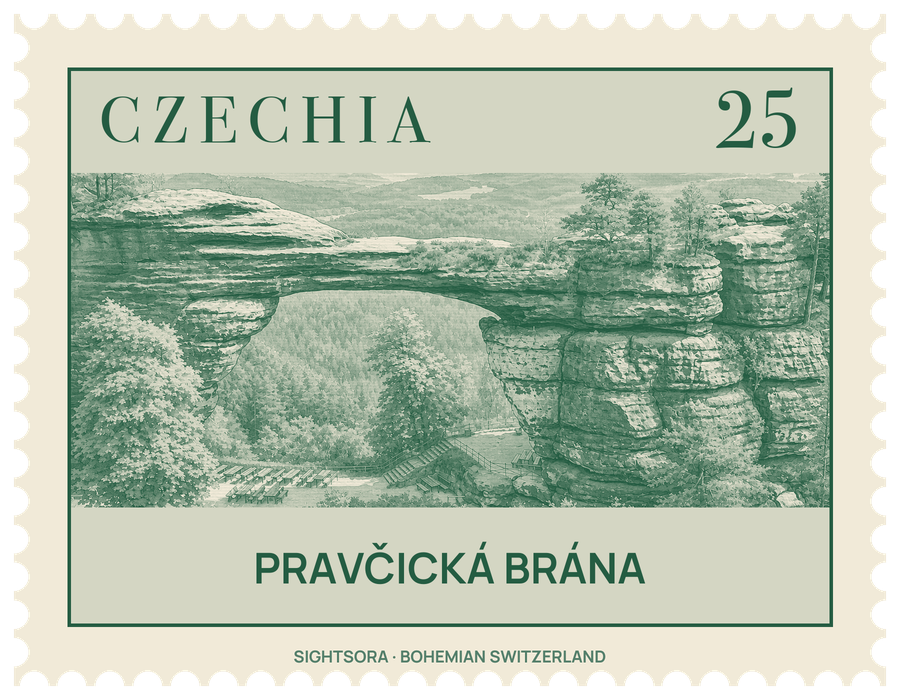
The opening beneath it is 16 metres high, the rock is up to 8 metres wide, and the arch itself is about 3 metres thick. Czech law protects it as a national nature monument, and it serves as the emblem of the whole region; German speakers know it as the Prebischtor.
The arch is the work of a very long process. Around 90 million years ago, late in the Cretaceous, a retreating sea left behind broad plateaus of soft sandstone, and the Elbe and the weather carved them into ravines, isolated blocks and gaps. The same forces are still at work, and the arch has grown more fragile; heavy wear from visitors led to it being closed to walkers in 1982, so the formation is now seen from around it rather than from its top.
Tourism here has a long history. An inn stood by the gate from 1826, and in 1881 Prince Edmund Clary-Aldringen, who owned the estate, brought in Italian craftsmen to build the Falkennest, or Falcon's Nest (Sokolí hnízdo in Czech), an extensive summerhouse and hotel next to the arch. He also laid a paved path up to the gate, opened woodland trails and started boat trips through a ravine close by, known ever since as Edmund Gorge after him. The estate around the gate has remained in private hands since the 19th century.
Romantic painters and writers were drawn to the place. In 1831 Carl Gustav Carus included the gate in a work on landscape painting written as nine letters, describing a scene of narrow ravines and rock masses, and in the same year a 26-year-old Hans Christian Andersen made his first visit. Much later the arch appeared in landscape scenes of the first Narnia film, The Lion, the Witch and the Wardrobe; because the rock can no longer be climbed, the shots of actors running across it were made in a studio. The long-distance Eisenach to Budapest mountain path passes the gate.
Getting there
There are two starting points for the walk to the gate, Hřensko and Mezní Louka, each with a car park; from Hřensko a red-marked trail leads up to the arch. By road, Hřensko lies 12 km from Děčín on the way to the border, and drivers from Dresden can use the border crossing between Schmilka and Hřensko. From Děčín, which has a railway station, buses run to Hřensko and on to Mezní Louka, also calling at u Třech pramenů. On the German side, trains stop at Schöna across the Elbe, from where a ferry crosses to Hřensko.