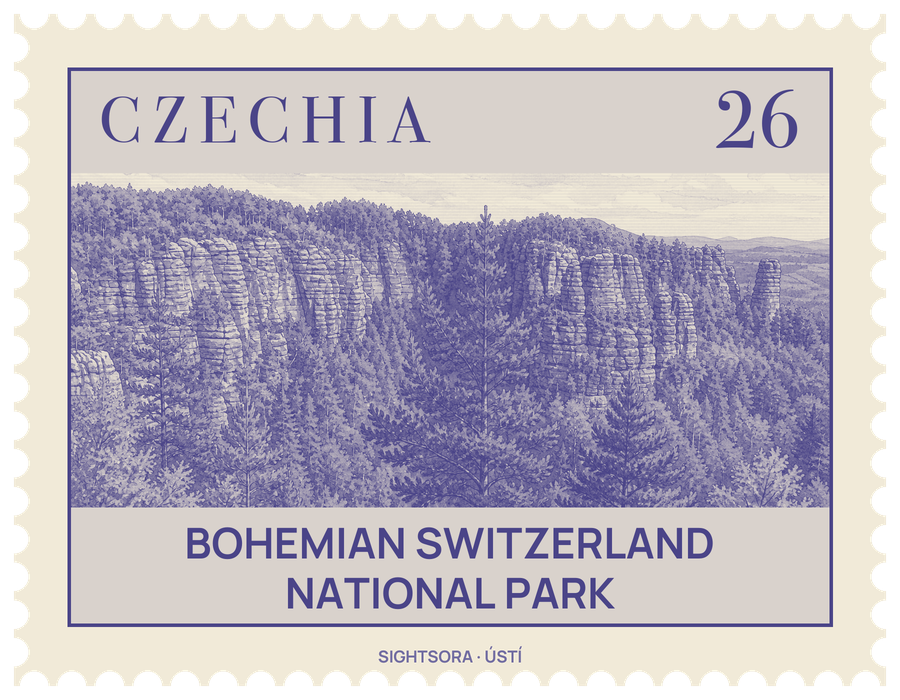
It takes up the eastern end of the Elbe Sandstone Mountains on their Czech side and adjoins Saxon Switzerland National Park in Germany; together the two are known as Saxon-Bohemian Switzerland. Declared in 2000, it is one of four national parks in the Czech Republic, and the park authority names its sandstone formations, with the habitats bound to them, as the main reason for its protection.
The name goes back to the 18th century, when two artists from Switzerland, Adrian Zingg and Anton Graff, found that the rocks of northern Bohemia reminded them of home. Crowds of tourists began arriving in the later 19th century, and Romantic artists such as the painter Ludwig Richter and the composer Carl Maria von Weber were inspired by its wild scenery. Protection came in stages: the whole area became a protected landscape in 1972, and on 1 January 2000 the forests and rocks, the Kamenice Gorge and the land around Růžovský vrch were given national park status.
The landscape is the main attraction. Its sights include the Pravčická brána, a great natural sandstone arch, and the park also has a smaller arch, Malá Pravčická brána. Near Hřensko the Kamenice Gorge cuts a rocky ravine, while around Jetřichovice the viewpoints of Mariina skála, Vilemínina stěna and Rudolfův kámen serve as lookouts. Pavlinino údolí follows the deeply cut valley of the Chřibská Kamenice stream, and the highest point of the area is Růžovský vrch at 619 m.
People have left their mark on the rocks as well. Castles were built here to guard the trade routes, and some served as hideouts for robber barons; the rock castles of Šaunštejn, near Vysoká Lipa, and Falkenštejn are among them. German-speaking settlers colonised the area in the 12th century, and the villages still keep well-tended Upper Lusatian houses; Na Tokáni is a historic inn that also works as a hostel. In 2022 a large fire started by people burned about 1,000 hectares of the park. The park administration has its seat in Krásná Lípa, with information offices at Hřensko and Jetřichovice.