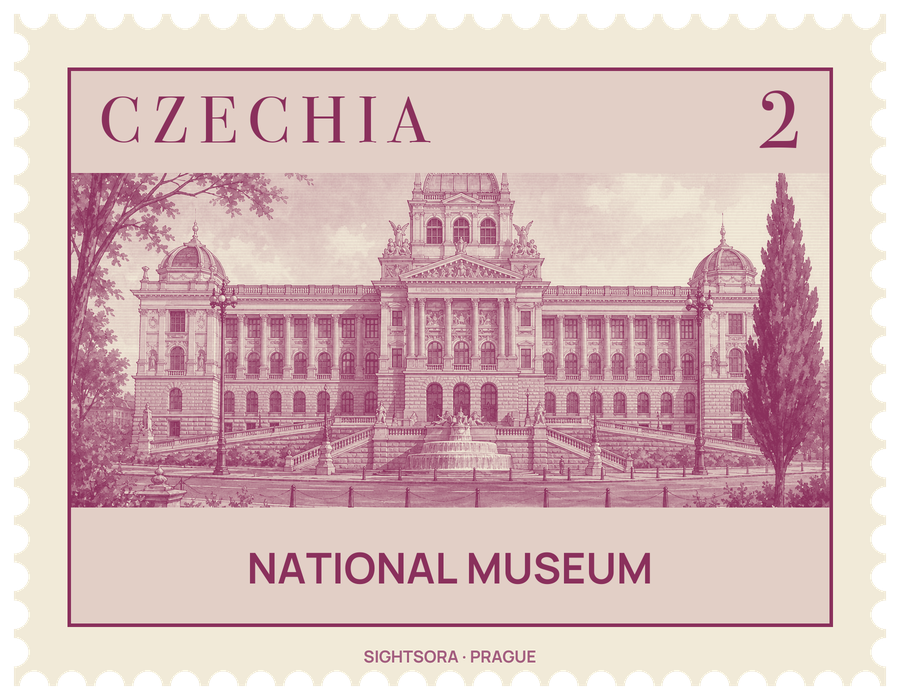
The institution behind it is far older: Count Kašpar Maria Šternberg founded it on 15 April 1818, with the historian František Palacký closely involved, and it grew into a centre of Czech national life at a time when the Bohemian nobility held learned life in its grip and most scholarly journals appeared in German. Today its collections run to nearly 14 million items in natural history, history, art, music and books, spread over dozens of buildings. Its commanding position has long made the building a natural gathering point for protests, rallies and public events.
The façade carries the marks of the 20th century. A bomb damaged the building in 1945, and during the Warsaw Pact intervention of 1968 Soviet machine-gun fire riddled its sandstone pillars, broke statues and reliefs and reached some of the storerooms. The bullet holes were filled in 1970–1972 with a lighter sandstone, so the patches can still be picked out. Metro construction in the 1970s and the opening of the North-South Highway on two sides of the building in 1978 brought noise, dust and vibration.
A long reconstruction closed the museum from 7 July 2011 to 28 October 2018, when it partly reopened for the centenary of Czechoslovak independence. In February 2019 the dome, which looks out over Prague, was opened to visitors for the first time, and the eastern courtyard received a roof. New permanent exhibitions followed: the Halls of Minerals in 2020, Miracles of Evolution and Windows into Prehistory, which traces life from the Protozoic to the Quaternary era, in 2021, and in 2022 a History exhibition covering the Czech lands from the 8th century to World War I.
Next door stands the New Building, put up in 1937 as the Prague Stock Exchange and extended in 1968–1973 for the Federal Assembly, the Czechoslovak parliament, with a great hung glass wall. Radio Free Europe and Radio Liberty used it from 1995 to 2009, after which it passed to the museum; an underground corridor has linked the two buildings since 2019, and in 2021 the building gained a permanent display on the History of the 20th Century. Among the medieval treasures of the Historical Museum are a silver ducal tiara from the twelfth century, the reliquary of St Eligius shaped like a mitre and the embroidered Rosenberg antependium of about 1370.
The museum also runs a string of separate sites across Prague and beyond, including the Náprstek Museum with its Egyptian exhibition, the Czech Museum of Music, the Bedřich Smetana Museum, the Antonín Dvořák Museum, the Lapidarium at Výstaviště and the National Monument at Vítkov.