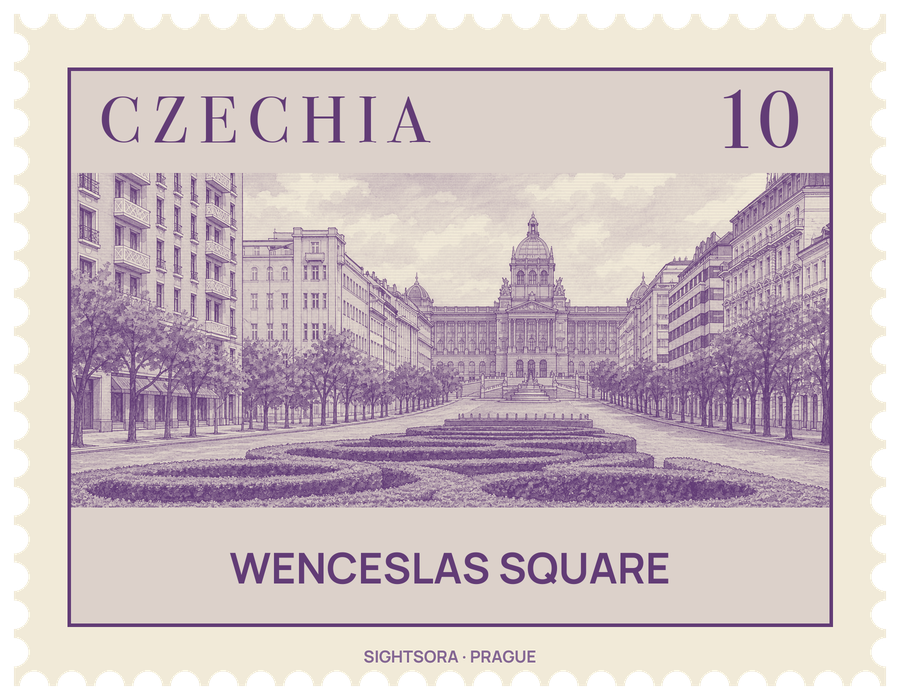
It is the commercial heart of Prague's New Town, lined with hotels, offices and shops, and it belongs to Prague's historic centre, which is inscribed as a World Heritage Site. Above all it is the place where Czechs gather, to celebrate and to protest, and many turning points of the country's modern history happened on this slope.
The square began as a market. When Charles IV founded the New Town in 1348, its plan set aside open spaces for trade, and this one became the Horse Market, Koňský trh, with the Horse Gate in the town walls at its upper end. In 1848 Karel Havlíček Borovský proposed giving it the name of Bohemia's patron saint, Wenceslas, whose Baroque statue had stood here since 1680; that older statue was moved to Vyšehrad in 1879. The present equestrian monument by Myslbek went up in 1912 at the top of the square, and the spot beneath the horse's tail, nicknamed Pod vocasem, has been the city's favourite meeting point since the 1960s.
The events tied to the square follow one another through the twentieth century. On 28 October 1918 Alois Jirásek stood before the statue and read aloud the declaration of Czechoslovak independence, and in 1938 huge crowds came here to protest when Nazi Germany demanded the Sudetenland. On 16 January 1969 the student Jan Palach set himself on fire on the square in protest at the Warsaw Pact invasion of 1968. In November 1989, during the Velvet Revolution, Václav Havel and Alexander Dubček stepped out side by side onto the balcony of the Melantrich Building at No. 36, above crowds that filled the boulevard.
The buildings along the slope make a walk through early twentieth-century architecture. At the top stands the National Museum, built between 1885 and 1891 to designs by Josef Schulz. Lower down are the Palác Koruna at Nos. 1–2, built in 1912–1914 and decorated by the sculptor Vojtěch Sucharda; Ludvík Kysela's Lindt Building at No. 4, an early piece of constructivism; the BAŤA shoe store of 1929 at No. 6; Jan Kotěra's Peterka Building at No. 12; Pavel Janák's Hotel Juliš at No. 22; and the Hotel Evropa at Nos. 25–27, redesigned in 1905 by Alois Dryák with sculpture by Ladislav Šaloun.
Getting there
Metro line A runs beneath the square. Muzeum station (lines A and C) has entrances at the upper end by the National Museum, and Můstek station (lines A and B) at the lower end; the northwestern end of the square is pedestrianised.