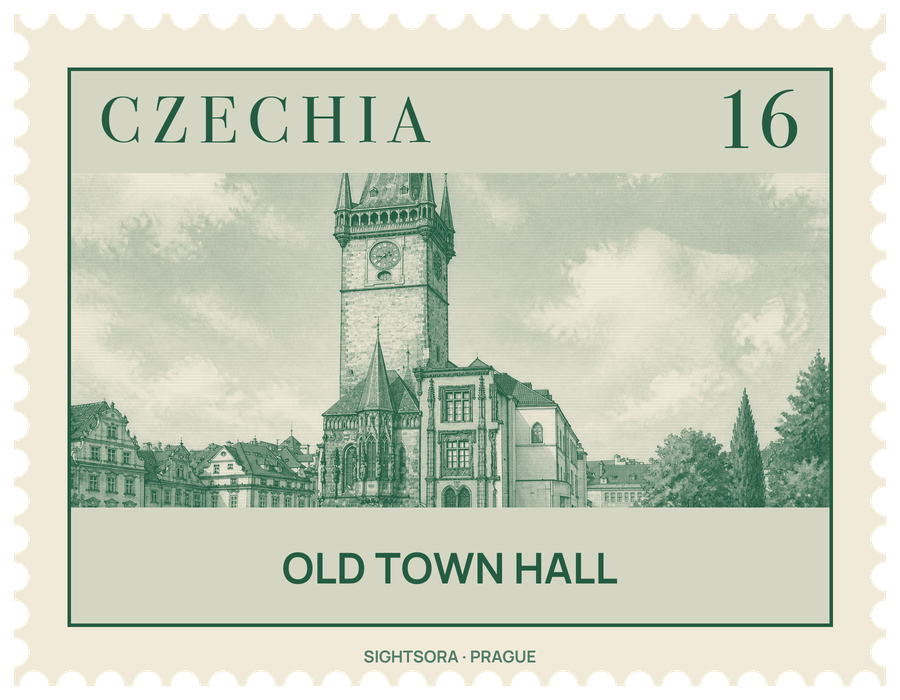
It began in 1338, when King John of Luxembourg let the Old Town councillors set up their own seat, and for it they purchased the Volflin family's large patrician house. The tower was finished in 1364, and over the following centuries the town kept buying neighbouring houses and adding them on, which is why the building reads as a chain of facades from different periods: Romanesque remains in the cellars, Gothic as the leading style, Renaissance windows and later Neo-Renaissance work. The astronomical clock built by Mikuláš of Kadaň in 1410 is set into the south face of the tower.
Much of Czech history passed through these rooms. In 1458 the Bohemian nobles chose Jiří of Poděbrady as their king here, and after the Battle of Bílá hora the leaders of the rebellion were held in the building; 27 of them were beheaded on the square outside on 21 June 1621, and crosses set into the paving mark the place. When the four Prague towns were merged in 1784, the hall became the seat of the joint city government, and couples have been married here since 1871. In May 1945 the basement was the command centre of the Prague Uprising; the building was shelled and set alight, the east and north wings facing the Týn church burned down, and the tower, the clock and the chapel were badly hit. The lost wings were never rebuilt, and the bare wall next to the tower was later fitted with a grille and memorial plaques.
The south facade is worth reading slowly. The entrance of the Volflin house has a late Gothic portal from the end of the 15th century, its ogee arch topped by a tall finial and closed by a wooden double door of 1652. Beside it, a window divided by a stone cross carries the arms of the Old Town and the Czech lion, with the letter W of King Vladislaus II. Further along, a Renaissance window bears the inscription Praga caput regni, Prague the head of the kingdom, and the house called At the Minute is covered in figural sgraffito from the early 17th century, uncovered beneath Baroque plaster only in 1905. High on the tower, the carved bay of the chapel consecrated in 1381 is decorated with human faces and animals, and a copy of the Gothic statue known as the Old Town Madonna stands at its corner.
The historical interiors, from the chapel and the state rooms down to the Romanesque-Gothic cellars, are shown on guided tours. The old council chamber keeps its late Gothic character from around 1470: a coffered wooden ceiling painted during the later 16th century and held by gilded chains added in 1638, walls hung with the coats of arms of 46 guilds and 12 towns, a Baroque tiled stove and a carved figure of the suffering Christ from the early 15th century. Below the figure an angel holds the warning Juste iudicate filii hominis, judge justly, sons of men. Next door, Brožík's Hall takes its name from Václav Brožík's two huge canvases of Jan Hus before the Council of Constance and the election of Jiří of Poděbrady, while Jiřík's Hall keeps early wall paintings and a bust of the king. In the vaulted entrance hall, mosaics after designs by Mikoláš Aleš show Libuše's prophecy of Prague's glory, and Myslbek's sculpture of the bard Lumír with the figure of Song stands beyond.
Visitors can climb the tower on foot or take the lift to its gallery, 42 metres above the square, for wide views over the city. The earlier lift, made in 1927, survived the fire of 1945 and went to the National Technical Museum; a barrier-free replacement has run in the tower since 2000.