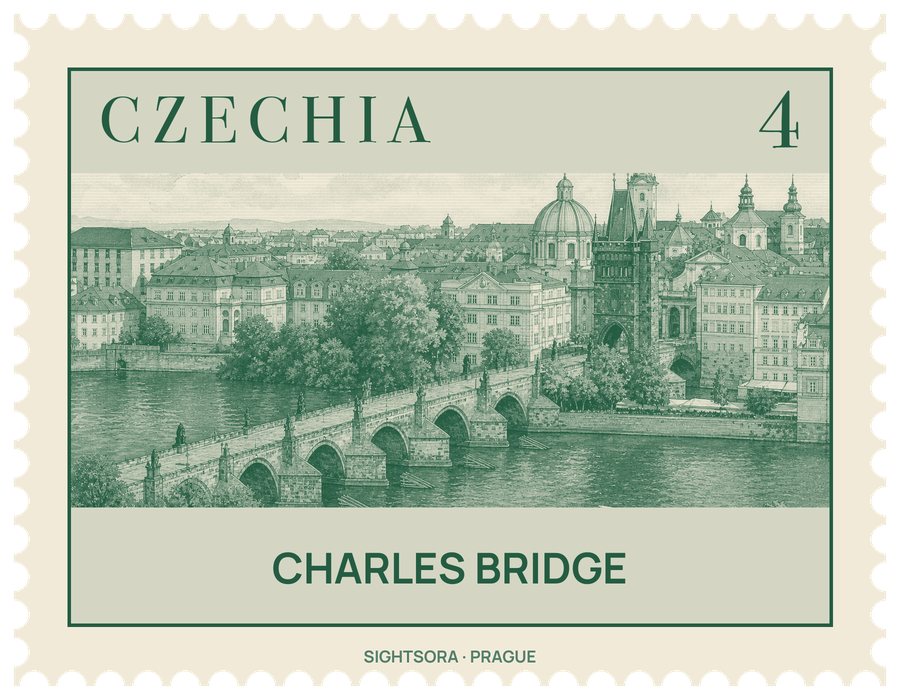
A gate tower guards each end: the Old Town Bridge Tower on the east bank and a pair of towers, among them the Malá Strana Bridge Tower, on the west. Along the parapets stand 30 statues and sculptural groups of saints, most of them Baroque. Since the major repair of 1965 to 1978 the bridge has been closed to all vehicles and belongs to people on foot.
Charles IV had the bridge begun in 1357 to replace the Judith Bridge of 1158–1172, which a flood had badly damaged in 1342; it was finished in the early 15th century, and modelled on the Stone Bridge in Regensburg, with ice guards shielding its arches. Legend says the emperor, a believer in numerology, laid the first stone early on the morning of 9 July 1357 at a minute chosen so that year, day, month, hour and minute written in a row read the same backwards. Until 1841 it was the only way across the river, so it served as the main link between the castle and the Old Town, part of the coronation route of the Bohemian kings and a land link that put Prague on the trade road joining the east and west of Europe. It was known as the Stone Bridge or Prague Bridge and has carried the name of Charles only since 1870.
The bridge has lived through floods and wars. After the Battle of White Mountain, the severed heads of the leaders executed in 1621 were displayed on the Old Town Bridge Tower as a warning. In 1648, in the last fighting of the Thirty Years' War, the Swedes held the west bank, and the heaviest fighting took place on the bridge itself, damaging the river side of the Old Town tower. In September 1890 logs and rafts swept downstream piled up against it until three arches were torn away and two pillars collapsed; the bridge reopened on 19 November 1892.
Most of the statues were put up between 1683 and 1714 by leading Bohemian sculptors of the day, among them Matthias Braun and Jan Brokoff, whose sons Ferdinand Maxmilian and Michael Joseph worked on it too. Among the best known are John of Nepomuk, St. Luthgard and the group of the Holy Crucifix and Calvary, and a separate statue of the knight Bruncvík was added about 200 years later outside the main row. The flood of 1890 carried two Brokoff statues into the river; in place of one of them Karel Dvořák later carved a group of Saints Cyril and Methodius. From 1965 every statue on the bridge has been swapped for a replica, and the originals are shown in the Lapidarium of the National Museum.
Repairs between 2008 and 2010 strengthened two pillars on the Malá Strana side and repaved the walkway, but replaced many stones in the walls in a way conservation professionals criticised, and in 2010 the UNESCO World Heritage Committee found the work had been done without adequate conservation advice.