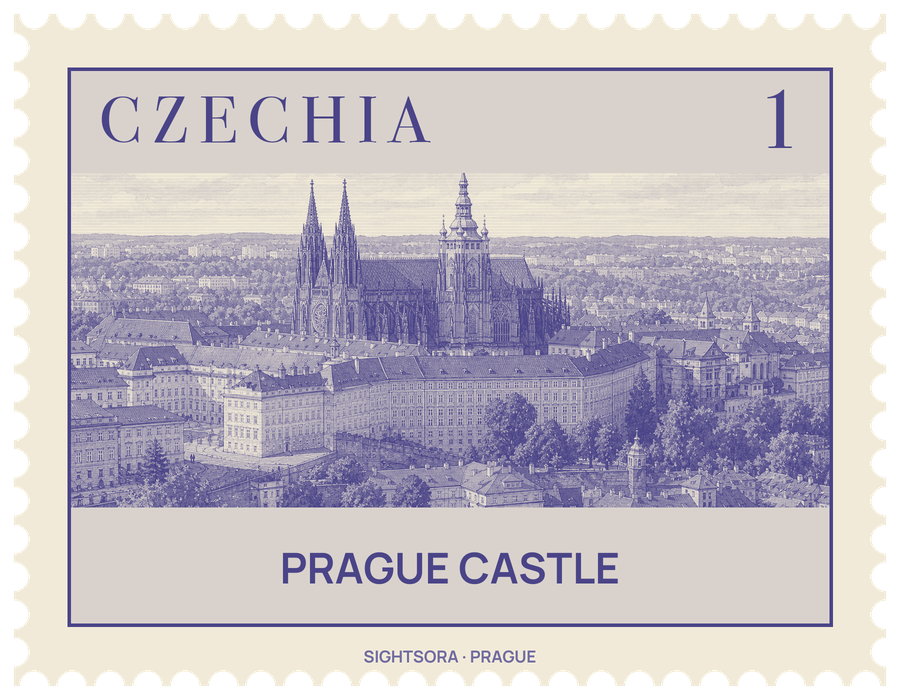
It has been the seat of power in Bohemia for more than a thousand years: Bohemian kings and Holy Roman emperors ruled from here, and since 1918 it has been the office and official residence of the head of state, first of Czechoslovakia and later of the Czech Republic. Czechs often say simply "Hrad", the Castle, when they mean the president and his staff. The Bohemian Crown Jewels are kept in a hidden room inside.
The story starts in 870 with a walled Church of the Virgin Mary, and during the early 10th century the Basilica of Saint George and the first church of St. Vitus were founded; the first convent in Bohemia grew up beside St. George's. Charles IV rebuilt the royal palace in Gothic style in the 14th century and began the great cathedral that took almost six centuries to finish. After the Hussite Wars left it empty, Vladislaus II Jagiellon started rebuilding in 1485 and added the vast Vladislav Hall, designed by Benedikt Rejt. A fire in 1541 destroyed much of the complex, and the Habsburgs added Renaissance buildings; Rudolph II made the castle his main residence and displayed his art collections in the Spanish Hall.
The castle was also the stage for turning points in the history of Bohemia. The Third Defenestration of Prague took place here in 1618 and set off the Bohemian Revolt; in 1648, at the close of the Thirty Years' War, the Swedes carried off many works from Rudolph II's collection. Empress Maria Theresa ordered the last major rebuilding in the later 18th century. After 1918 the Slovenian architect Jože Plečnik reshaped the New Royal Palace and the gardens for President Tomáš Masaryk, and St. Vitus Cathedral was completed on 28 September 1929. During the Nazi occupation the castle served as the headquarters of Reinhard Heydrich.
Walking through the courtyards, visitors pass buildings from almost every period of the last millennium. Beside the Gothic St. Vitus Cathedral stands the Romanesque St. George's Basilica, the oldest surviving church building in the castle, along with All Saints Church and the Holy Cross Chapel. The Old Royal Palace holds Vladislav Hall, and other halls include the Spanish Hall, Rudolph's Gallery and the Column Hall. The fortifications keep the White Tower, the Black Tower, Daliborka and Mihulka, and the row of small houses called Golden Lane runs inside the walls.
Most of the castle grounds are open to visitors, and several museums are housed within them: Bohemian mannerist and baroque art from the National Gallery collection, a Toy Museum, an exhibition on Czech history, and the castle's Picture Gallery, which grew from Rudolph II's collection. Outside the buildings there are gardens to explore, among them the Royal Garden with its Orangery, the South Gardens and the Garden on the Ramparts, as well as Queen Anne's Summer Palace, the Belvedere, which Ferdinand I built for his wife Anne. Kohl's Fountain, the Matthias Gate and a statue of Saint George stand in the courtyards, and the Summer Shakespeare Festival is held in the courtyard of the Burgrave Palace.