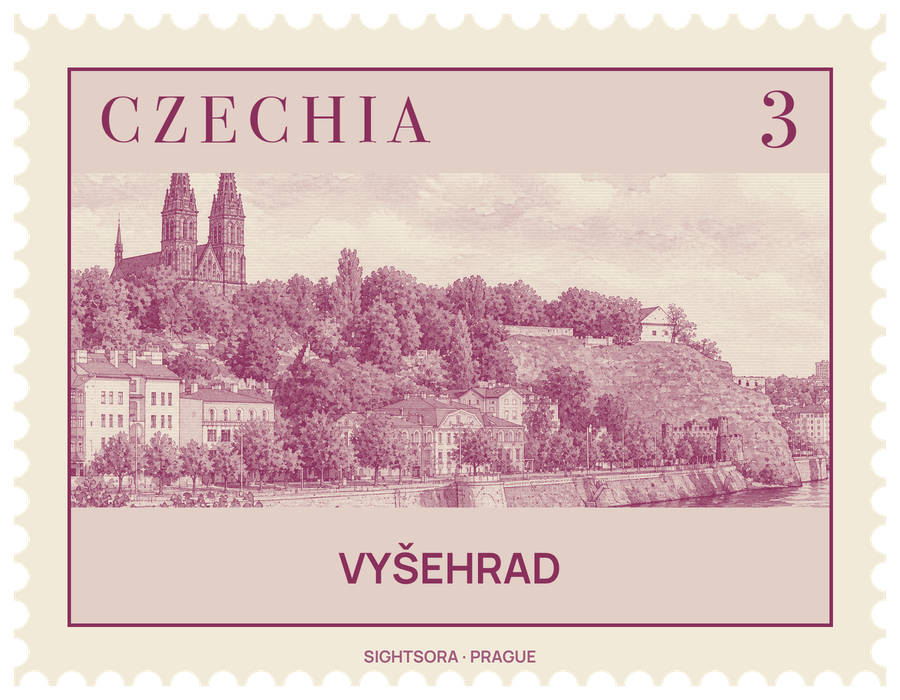
It was probably founded in the 10th century, and Czech legend places some of its oldest stories here. The site describes itself as the rock of Czech history and traces its path from royal castle to fortress and finally to national symbol; it is protected as a National Cultural Monument, and Prague residents use its parks for walks and celebrations, among them New Year's Eve.
For about two centuries Vyšehrad and Prague Castle were rival seats. Its high point came after Vratislav II moved his court here in the later 11th century and the fort became a palace complex with a church and a chapter house; around 1140 Prince Soběslav returned to Prague Castle. Charles IV later renewed it with new walls, two gates and a royal palace, but the Hussites sacked it in 1420, and in 1448 soldiers loyal to George of Poděbrady plundered it again, after which it fell into ruin. From 1654 the Habsburgs turned the hill into a Baroque fortress for the imperial army, and that remodelling gave Vyšehrad the shape visible today, with its ramparts and the Tábor and Leopold gates. The Empire-style Brick Gate, Cihelná brána, dates from 1841.
Only a few medieval fragments survive: the main part of the Špička Gate, pieces of a Romanesque bridge and the ruined Gothic lookout known as Libuše's Bath. The small Romanesque Rotunda of St. Martin goes back to the second half of the 11th century. Above everything rises the Basilica of Saints Peter and Paul, founded in the 11th century and rebuilt in neo-Gothic style in 1885 and 1887; its rich decoration recalls the early days of Christianity in the Czech lands. Beside it, the Vyšehrad Cemetery with the monumental Slavín tomb holds leading figures of Czech culture, among them the composers Bedřich Smetana and Antonín Dvořák, the writer Karel Čapek and the artist Alphonse Mucha, and its graves make it an open-air gallery of sculpture.
When Vyšehrad became a fortress, a maze of underground casemates was dug beneath it; the corridors run for more than one kilometre in four separate sections. On the walls of a former artillery redan an open-air theatre looks across to Prague Castle, and walks along the ramparts give wide views over the city. South of the basilica stand Josef Václav Myslbek's statues of figures from Czech legend, moved here from Palacký Bridge: Libuše and Přemysl, Ctirad and Šárka, Lumír and Píseň, and Záboj and Slavoj. On the northwest bastion stands Johann Georg Bendl's Saint Wenceslas.
Legend says Duke Krok founded the castle on the steep rock above the river, and that the knight Horymír escaped imprisonment here by leaping over the walls on his horse Šemík. The site's own historians point out that the oldest chronicles do not mention Šemík: the tale first appears in the Czech Chronicle of Václav Hájek of Libočany. They also note that the seat of Krok and his daughter Libuše is not actually known and probably lay somewhere near the Berounka, some 30 km away.