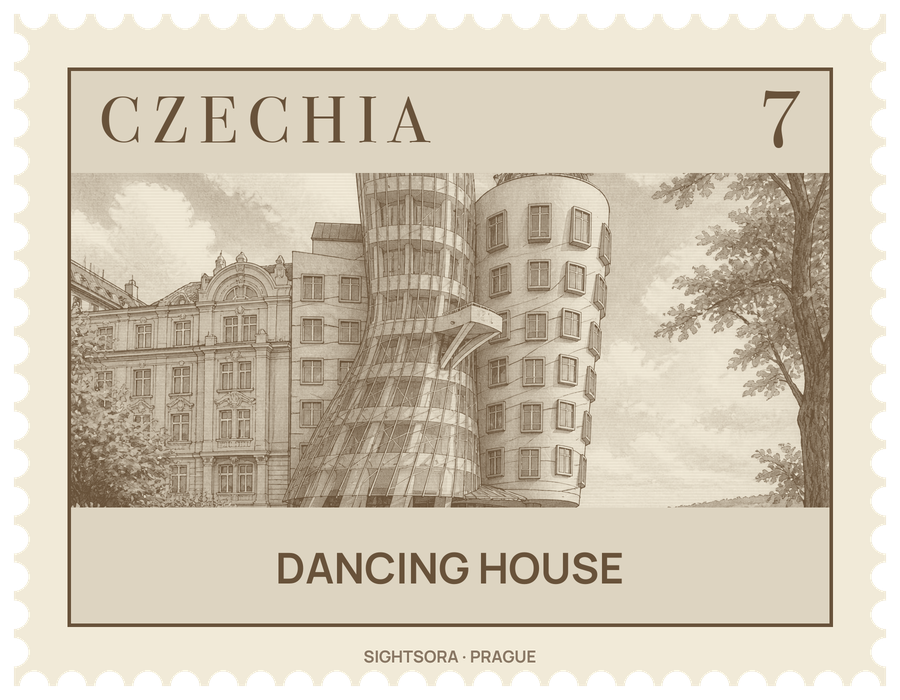
Vlado Milunić, a Croatian-Czech architect, designed it together with Frank Gehry in 1992, and the building was finished in 1996. Gehry first named it Ginger and Fred, because the two towers look like a couple of dancers, though he later dropped the name himself.
The plot has a history of its own. An apartment block that stood here was destroyed by American bombs in 1945, and the ruins were not cleared until 1960. Next door lived the family of Václav Havel, and Milunić talked over an idea for the empty site with his dissident neighbour as early as 1986. After the Velvet Revolution Havel became president, and his backing helped the project move forward. Milunić's concept of a building in two halves, one static and one in motion, was meant to stand for Czechoslovakia's passage from communist rule to parliamentary democracy.
The designers called the style "new-baroque"; critics file it under deconstructivism. Ninety-nine concrete panels, each with its own shape and size, carry the curving form. The rock tower stands for Fred and wears a metal head, while the glass tower is Ginger, narrowing halfway up and resting on curved pillars. On the roof sits a big twisted metal structure nicknamed Medusa. The uneven windows have projecting frames like picture frames, and they hide the fact that the building squeezes in two more floors than its nineteenth-century neighbours while staying at the same height.
Eva Jiřičná, a Czech-British architect, designed most of the interior, borrowing tricks from ship design to make use of the narrow, asymmetric floors, where no two levels share the same layout. Part of the building was turned into a small hotel in 2016, and an art gallery also operates inside. The building's outline appears on a gold 2,000-koruna coin from the Czech National Bank, part of the series "Ten Centuries of Architecture". Not everyone welcomed it: some critics still see its shapes and materials as out of place among Prague's Baroque, Gothic and Art Nouveau streets.