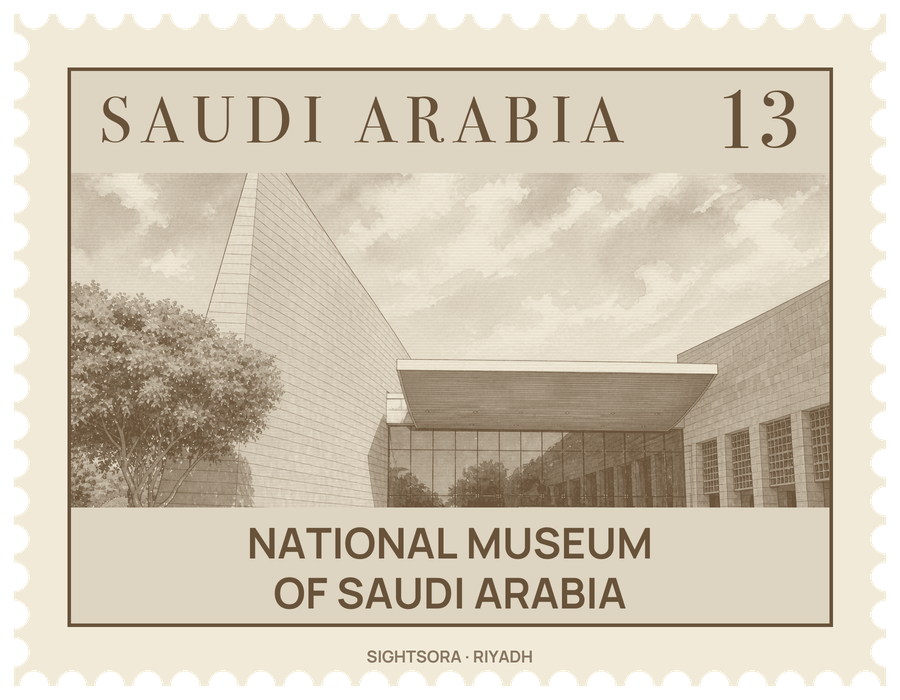
It opened in 1999 as part of the King Abdulaziz Historical Centre, with al-Wadi Park to its north and al-Madi Park to its east. It was built for the centennial celebrations in only 26 months, as part of a plan to renew the area around the old Murabba' Palace.
The architect Raymond Moriyama gave the west facade on Murabba' Square the soft line of a sand dune, and laid it out as a crescent pointing towards Mecca. Inside, the exhibitions are arranged in eight halls that move through the history of the Arabian Peninsula, among them the Pre-Islamic Era, Islam and the Arabian Peninsula, the First and Second Saudi States, and the Hajj and the Two Holy Mosques. Near the end, visitors pass into the Unification Drum, devoted to the present Saudi State, and the final gallery shows the two holy mosques and the pilgrimage. Two more galleries host special exhibitions.
The museum tells its story differently from a classic museum of treasures. Rather than setting single valuable objects apart, it relies on many replicas and life-size dioramas to explain ideas and periods, so the displayed pieces serve as examples of a wider theme. As a result, it is not always easy to tell a replica from an original.