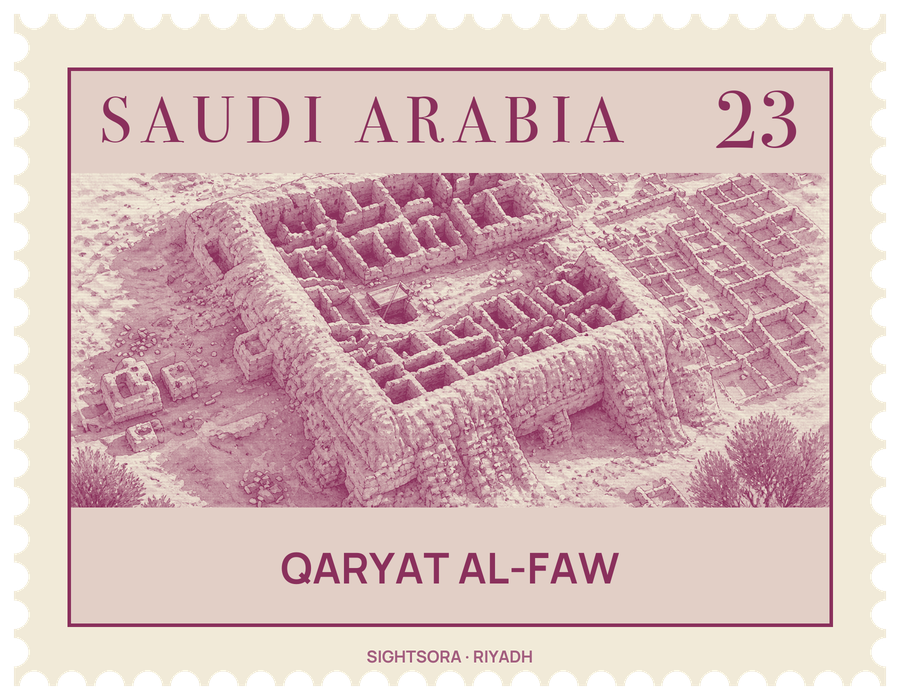
Its ruins include houses, markets, streets, temples, cemeteries and water wells. In July 2024 the site was added to the UNESCO World Heritage List as the cultural landscape of the Al-Faw archaeological area.
The town grew up in the fourth century BC on the caravan route between southern Arabia and the northeast of the peninsula, and it prospered from the 3rd century BC to the 3rd century AD as a trading hub with more than seventeen wells. Its people called it Qaryat al-Hamraa, the Red City, and Dhat al-Jnan, the City of Gardens; it is also known as Qaryat Dhat Kahil, and Kahl, the main god of the Kinda and Madh'hij tribes, is thought to have been its guardian deity, with Shams among the other gods worshipped here. Around 300 AD the Kinda left for Hadhramaut, and soon afterwards the town was deserted.
The city was laid out with care: it had no fortifications as such but was enclosed by long walls and divided into quarters for the royal palace, temples and housing, with canals and cisterns bringing in water. Five temples of different periods have been found. At the centre stood the Temple of Wadd, a rectangular building of limestone blocks, alongside the palace and a fortified building known as a suq, whose stone outer walls were faced with mud brick. In the palace area, two halls with stone columns and benches along the walls seem to have been used for receptions and assemblies.
Qaryat al-Faw is best known for its wall paintings. Fragments range from simple geometric line work to refined scenes with a sense of naturalism and perspective, painted mainly in white, ochre, red and black, with occasional touches of blue. The most famous piece, from a painted room in the Temple of Shams, carries the word 'zky', meaning pious or blessed, and probably dates from the first century CE; its human figures, camel drivers and mythological motifs framed by vines and grapes suggest an artist trained in Roman Egypt. The temple also housed a mrzh, a ritual banqueting hall whose frescoes, with reclining diners, amphorae and chariots, show how far Hellenistic culture had reached into central Arabia.
Kings and nobles were buried in stone-built chambers topped by a tower or mausoleum, and a bust of Artemis was found in this area. Tombs of nobles and warriors line the eastern edge of the city, while the king's tomb stands apart to the northwest. The market's walls have eroded heavily, burying nearly a whole storey of what was once a building of three or four levels, though traces of grain stores and baking ovens remain. East of the city rises a large jebel with caves and petroglyphs.
Aramco workers mentioned the ruins in the 1940s, and teams from King Saud University excavated here from the 1970s, uncovering a residential sector of houses, squares, streets and a market, and a sacred sector of temples and tombs.