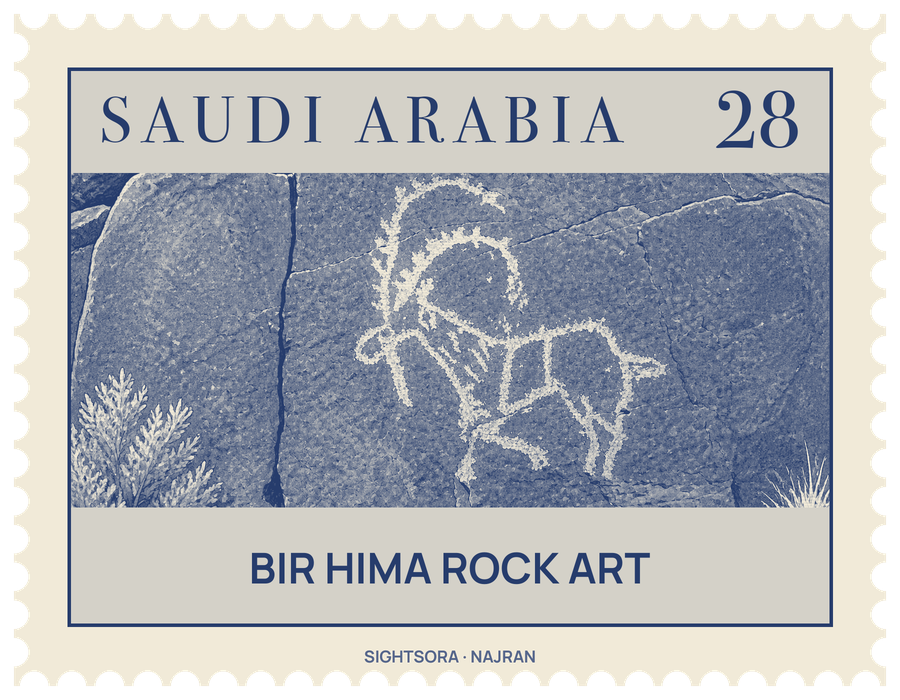
People lived here in the Palaeolithic and Neolithic, drawn by wild animals, water and the limestone terrain, and the Bir Hima Complex spans the period from 7000 to 1000 BC. In July 2021 it became part of the Hima Cultural Area World Heritage Site.
The images were first studied after the Philby-Ryckmans-Lippen expedition of 1951; one member recorded 250 images at a site west of the old wells. The early finds included daggers and swords, bows with arrows, sickle swords and throw-sticks, and the carving tools themselves, choppers and pebble tools of quartzite, andesite and flint, were found here too. The archer known as the Bir Hima warrior closely matches the men shown on the Hunters Palette. Numerous troughs, of a type found from North Arabia to Yemen, also survive at the site.
Up to 6,400 figures of people and animals have been recorded across the wider Najran area, more than 1,800 of them camels and 1,300 human figures. Thousands of inscriptions accompany them, in scripts ranging from Thamudic, Aramaic-Nabatean and the al-musnad alphabet to other South Arabian, Greek and Islamic writing. Among them are sixth-century inscriptions of Dhu Nuwas, the Himyarite king who occupied Najran; the best known, Ja 1028, sheds light on the killing of Najran's Christian community. The protected area of 'Uruq Bani Ma'arid lies 180 km to the northeast.