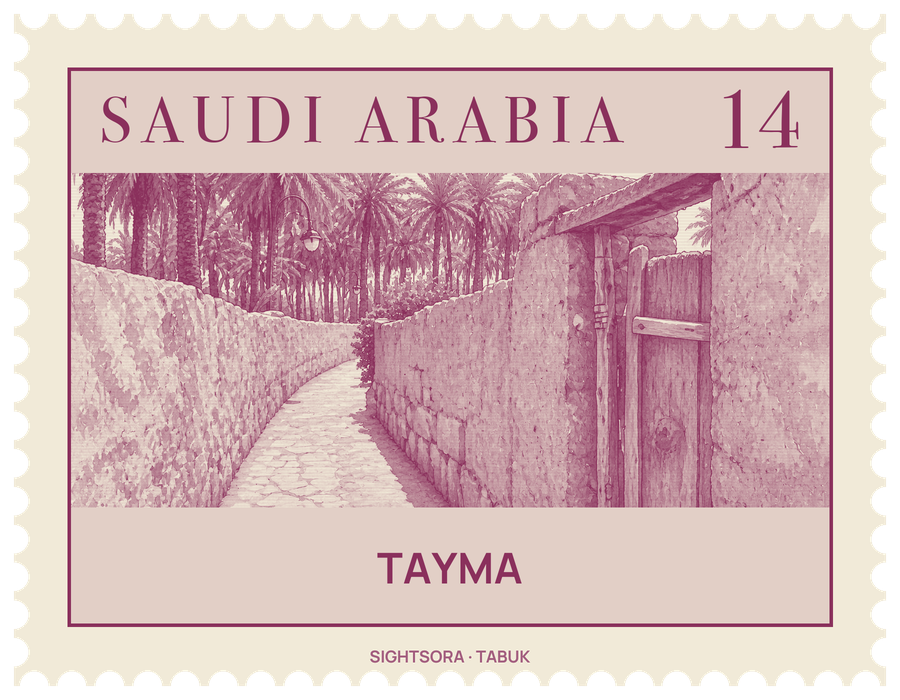
Its steady water made it a stopping place on the trade route that linked South Arabia with the eastern Mediterranean, at a crossroads between Arabia, Mesopotamia, the Levant and Egypt. Ancient walls, palaces and inscriptions survive around the modern town.
People settled here as early as the 4th millennium BC, and by the middle of the 2nd millennium BC a massive wall of mudbrick and sandstone enclosed the oasis. In 2010 an inscription in Egyptian hieroglyphs, the first ever found in Saudi Arabia, carved for the pharaoh Ramesses III, was discovered about 60 kilometers northwest of the town. Tayma appears in Assyrian records from the eighth century BC, and the last Babylonian king, Nabonidus, used it as his base for campaigns in northwestern Arabia. The Hebrew Bible names it several times as Tema, a commercial city.
In late antiquity Tayma had a Jewish population, and pre-Islamic poets called it a fortified city of the Jews. On the southwest side of the city, Qasr Al-Ablaq was built in the 6th century by the poet and warrior Samaw'al ibn 'Adiya together with his grandfather. Medieval Arab geographers praised the oasis for its spring, wells and palm groves with excellent dates, and al-Bakri described its city walls, which still give the ruins their outline. Later, pilgrims travelling from Syria to the holy cities rested at the oasis.
Visitors can see Qasr Al-Ablaq, Qasr Al-Hamra, a palace from the 7th century BC, Qasr Al-Bejaidi, and the 6th-century BC wall that encloses the old city on three sides. Aramaic, Lihyanite, Thamudic and Nabataean inscriptions are found across the area, as are clay tablets and stones in the local Taymanitic script. The best-known find, the Tayma stele, which lists the town's gods and was found by Charles Huber in 1883, is now in the Louvre.