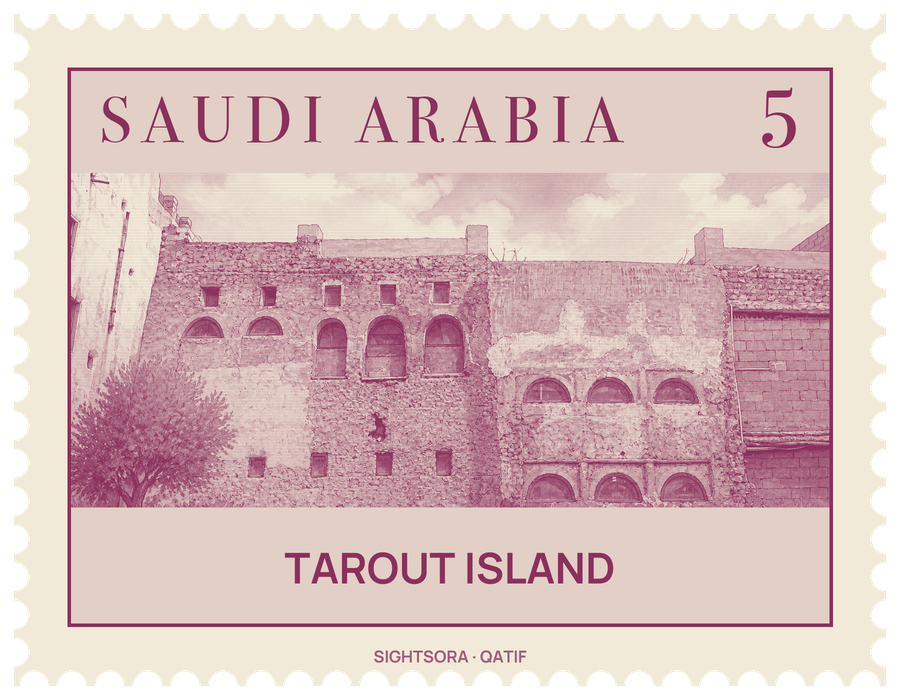
Archaeological finds show people living here for more than 5,000 years, and the island was a link in the trade between Mesopotamia, the Indus Valley and the Arabian Peninsula. It is counted as the heart of the ancient Dilmun Kingdom.
Much of what is known about early Tarout came to light by chance. Sand dug from the mound of Tell Rafī'ah in 1962 for the causeway to Qatif turned up Stone Age pottery and a statue; Danish archaeologists in 1968 found pottery going back to 4,500 BC; and tombs of around 2000 BC appeared during work on a car repair workshop. Tell Rafī'ah also produced carved steatite vessels decorated with cats, nude men and scenes of the sea and fishing. A gold statue of the goddess Ashtaroot was found in a palm grove, and a 94 cm statue of a standing man in dark grey stone, almost certainly Sumerian, was found by a farmer in the 1950s; it was later restored and now stands in the National Museum of Riyadh.
Tarout Castle stands at the centre of the island on a small hill called Tall Tawt, above the old quarter of Al Deyrah. Its first structure dates from the Uyunid dynasty, built over ruins that go back as far as 5000 BC, and the fort took its military form between 1515 and 1521 under the Portuguese, who held it until they were forced to hand it over in 1559 and withdrew to Bahrain. An old army cannon found at the site is shown in the Dammam Regional Museum.
Both of the island's traditional harbours, Darin on the south coast and Sanabes on the northeast, keep traces of ancient settlement, and in earlier centuries the whole island was often known as Darin. The Treaty of Darin between Ibn Saud and the United Kingdom was signed here in 1915. Facing the Darin harbour, beside the ruins of a palace, a traditional house about two hundred years old serves as a visitor centre and museum. Other sights around the island include the site of the Al Rafiea airport, built by the British in 1911, and the remains of the Fortress of Abu Al-leaf between Tarout and Qatif.
Getting there
Three causeways connect the island with Qatif City on the mainland, about six kilometres away.