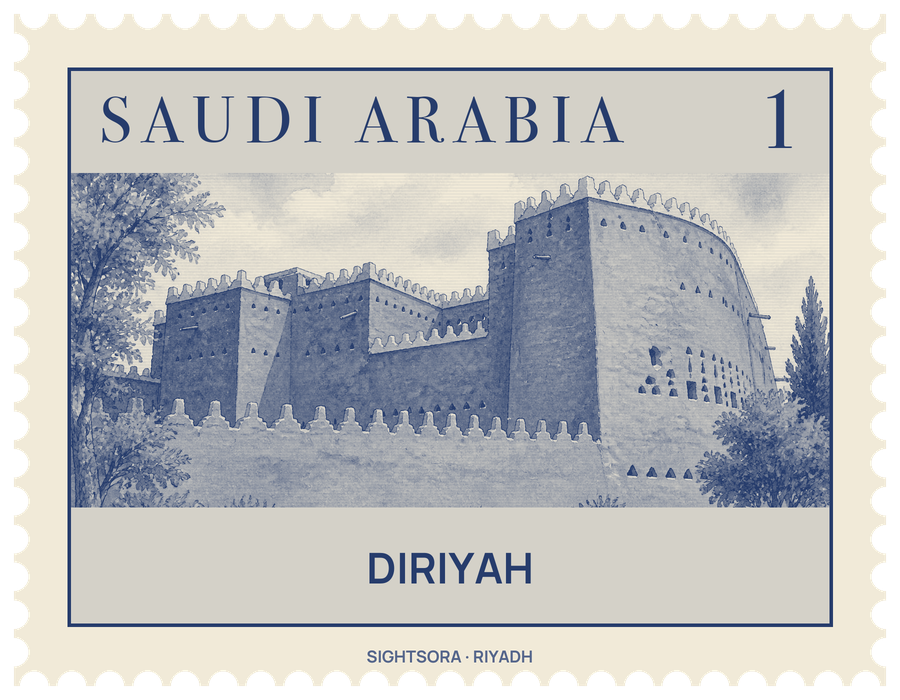
This was the first home of the House of Saud, and between 1727 and 1818 the first Saudi dynasty ruled its emirate from here. Its At-Turaif District, the first Saudi seat of power, was added to the UNESCO World Heritage list in 2010.
Chroniclers of Nejd date the founding to 1446–47 and credit it to Mani' Al-Muraydi, an ancestor of the royal family whose clan came from the Al-Qatif area at the invitation of Ibn Dir', after whom the place was named. In 1744 the emir Muhammad ibn Saud gave shelter to the scholar Muhammad ibn Abd al-Wahhab, and the alliance between them gave birth to the First Saudi State, which within a few decades ruled most of Arabia. The capture of Mecca and Medina brought an Ottoman and Egyptian army under Ibrahim Pasha, which broke into Turaif in 1818 after a long siege, razed the houses, cut down the palm groves and later burned what remained. When the Saudis rebuilt their power in 1824 and again in 1902, they chose Riyadh as their capital, and old Diriyah was left as a shell; the British writer Robert Lacey likened it to "a sand-blown Pompeii".
The ruins fall into three districts on the hills above the wadi: Ghussaibah, Al-Mulaybeed and Turaif. Turaif stands highest, and visitors can walk up to it from below. Stretches of the mud-brick wall along the edge of the valley survive together with some tall watchtowers, and several of them, including the Burj Faysal, have been rebuilt. To the north, Ghasiba is a separate walled site on the edge of Wadi Hanifah, thought to go back to the 17th century.
The largest building in Turaif is Salwa Palace, where the Saudi imams and amirs lived in the time of the First Saudi State. It rises four storeys, was put together in five parts over successive periods and probably completed under Saud ibn Abdul Aziz, imam from 1803 to 1814; it now serves as a museum. The palace of Sa'd ibn Sa'ud, son of the imam Abd Allah and a leading figure in the battle of 1818, is known for its courtyard that served as a stable. The Guest House and the At-Turaif Bath House are built around small courtyards, and the bath house shows how different plasters were used to keep water out; both drew water from a well in the wadi.
Across the wadi from Turaif lies the al-Bujairi Heritage Park, with the restored al-Zawiharah mosque and its underground prayer chamber, a feature of older mosques in Najd, and the al-Sarikhah mosque, a modern building in the traditional central Arabian style. North of al-Bujairi, the Museum of Bygone Days shows how people lived day to day in central Arabia during the first half and middle of the 20th century, and the Bujairi Terrace is a dining area in Najdi style that looks straight across to the At-Turaif District. Several other palaces in the old city have also been restored as museums.