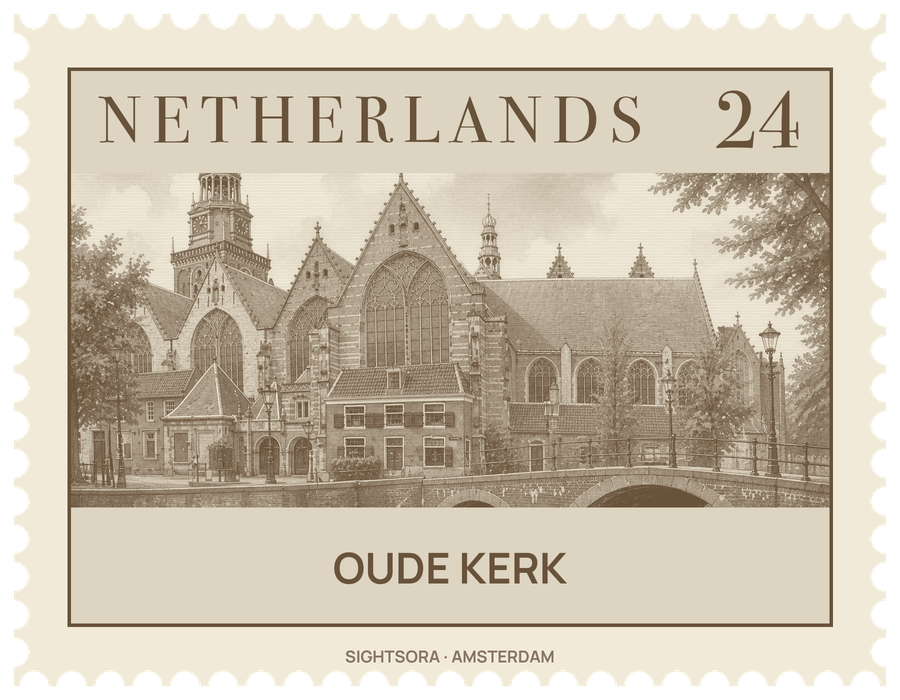
A wooden chapel stood on the spot by around 1213; in 1306 the bishop of Utrecht consecrated the stone church that replaced it and dedicated it to Saint Nicolas. After the Reformation of 1578 it passed to the Calvinists and remains a Reformed church, while since 2012 it has also been a venue for contemporary art.
Generations of Amsterdammers kept enlarging the building. Its aisles were extended around the choir about fifty years after the consecration, and north and south transepts turned the plan into a cross, work that was finished in 1460 despite the city fires of 1421 and 1452. In the Beeldenstorm of 1566 a crowd destroyed most of the church's art, including an altarpiece by Jan van Scorel and Maarten van Heemskerck; only the ceiling paintings, out of reach, survived. Overhead, the wooden vault is made of Estonian oak planks dating from 1390 and is known for its acoustics, and the choir has 12 misericords.
The church was built on a cemetery, and its whole floor is paved with tombstones: some 2,500 of them cover the graves of around 60,000 people, as burials continued inside until 1865. Among them are the composer and organist Jan Pieterszoon Sweelinck, the naval commander Jacob van Heemskerck, Kiliaen van Rensselaer and Frans Banninck Cocq, the burgomaster at the centre of Rembrandt's The Night Watch. Rembrandt came here often and had all his children baptised in the church; his wife Saskia van Uylenburgh was buried here in 1642, and each year on 9 March, or on 8 March in a leap year, the morning sun briefly falls on her tomb.
Details from later centuries are still in place. An oak screen of 1681 closes off the choir, with an inscription recalling the end of the 'misuse of God's church' in 1578, and the iron chapel once kept the chest of the city's most valuable documents. Of the four organs, the best known was built in 1724 by Christian Vater and later strengthened by Casper Müller, hence the name Vater-Müller organ; a bust honours Sweelinck, who became organist here at fifteen and set all 150 Psalms to music.
Visitors find a permanent display on the history of the church and of Amsterdam, alongside new works that invited artists make specially for the building and that are shown only once. Artists commissioned for site-specific installations have included Janet Cardiff with George Bures Miller, Christian Boltanski, Marinus Boezem and Nicolas Jaar.