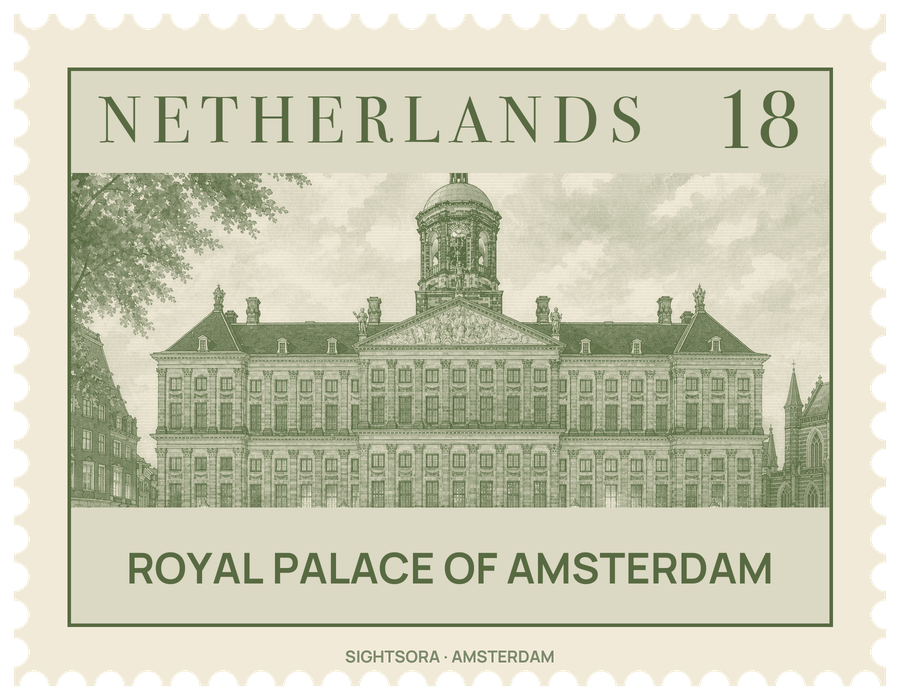
It stands opposite the War Memorial with the Nieuwe Kerk beside it, and by Act of Parliament it is one of three Dutch palaces placed at the monarch's disposal. Because it was designed for the city council rather than a court, it has no grand entrance of the kind most royal palaces have.
Burgomaster Nicolaes Tulp commissioned the new stadhuis before the old city hall burned down on 7 July 1652, and Jacob van Campen was in charge of building it from 1648. It rests on 13,659 wooden piles. Burgomaster Cornelis de Graeff opened it on 29 July 1655, and on its completion in 1656 it became a sight that foreign visitors came to see, with artists recording and copying the works of art in its public rooms. The pale yellowish sandstone has darkened a great deal over the centuries, and on the rear of the building a statue of Atlas, 6 metres tall, carries the globe on his shoulders.
The change of use came under Louis Bonaparte, made King Louis I of Holland in 1806. He moved to Amsterdam in 1808, took over the city hall as his palace and turned its public rooms into a national museum, which opened to the public in 1809 with paintings such as Rembrandt's The Night Watch. To open up the view from his new residence he had the old weigh house on the square pulled down. Once Napoleon had fallen and the Kingdom of the Netherlands was formed in 1815, the building passed to the Dutch Royal House, and in 1936 it became property of the state.
The monarch still uses the palace for state visits and official receptions, including New Year receptions, and it hosts the award ceremonies of the Erasmus Prize, the Silver Carnation, the Royal Awards for Modern Painting and the Prince Claus Awards. Its balcony has framed two changes of reign: in 1980 Juliana presented her daughter Beatrix to the crowd as the new queen, and in 2013 Beatrix stood there to announce her son Willem-Alexander as king. On most days of the year the public floors are open as a museum, where rooms such as the central hall and the bedroom of King Louis Bonaparte can be seen.