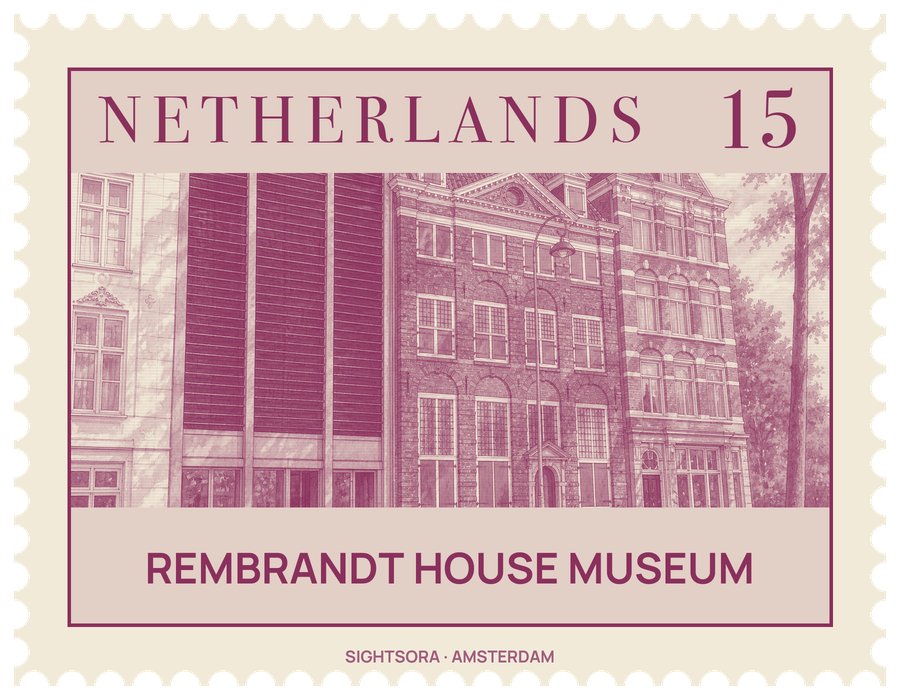
The house dates from around 1606; in about 1627 it gained an extra storey and a new front with a triangular pediment, probably under Jacob van Campen. The price Rembrandt agreed on 5 January 1639 was thirteen thousand guilders; after his bankruptcy the house went to auction in 1658 and sold for eleven thousand.
By the early 20th century the building was in poor shape. The city of Amsterdam bought it in 1907, following the Rembrandt Year of 1906, and passed it to the Rembrandthuis foundation; the idea of a museum came from the painter Jozef Israëls. Karel de Bazel restored the house between 1907 and 1911, and it opened on 10 June 1911, with Queen Wilhelmina and Prince Hendrik as its first visitors.
Inside, the rooms are furnished to show how Rembrandt lived and worked: his living room, the art room where he kept his collection, and the studio. They were set up again in the 20th century using the inventory of his possessions drawn up at his bankruptcy in 1656. The 17th-century bed in the bed-sitting room is not Rembrandt's own but resembles the original, and the collection room has been recreated. Paintings by his teacher Pieter Lastman and by his pupils Ferdinand Bol and Govert Flinck hang in the house; Bol's Shepherdess in a Landscape, from about 1641, is in the former living room.
The museum holds an almost complete set of Rembrandt's etchings and some of his original copper plates, shown in turn in the etching cabinet and in exhibitions in the modern wing next door, which also has the shop. Two small pots found in 1997 in the house's cesspool were shown by research in 2019 to have been used by Rembrandt himself; one still holds traces of the quartz-and-clay mix he spread on his canvases before painting, and both are on display. The modern wing hosts temporary exhibitions on Rembrandt, his contemporaries and later artists, and since 2023 a yearly Rembrandt Open Studio has invited contemporary artists to work in the house.