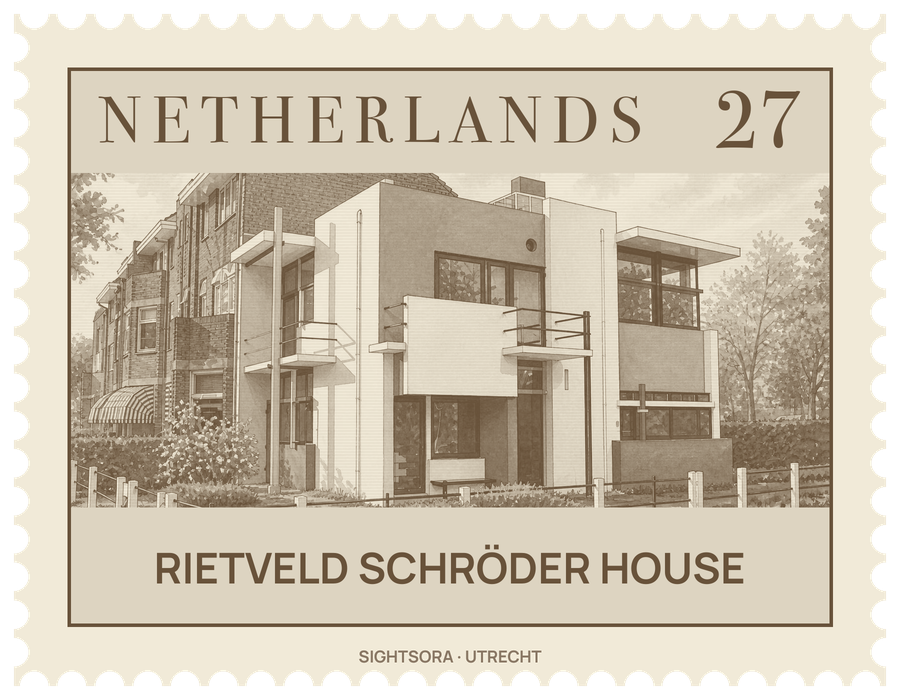
Gerrit Rietveld built it in 1924 for Truus Schröder, a mother of three who had just lost her husband, and it is among the best-known buildings of De Stijl, the art movement named after a magazine founded in 1917. Listed as a monument since 1976, it was added to the UNESCO World Heritage list in 2000.
Rietveld was then known as a furniture maker, above all for his Red and Blue Chair of around 1919, and this was his first complete house. Schröder worked with him on every part of the design: she wanted a sober house, ideally without walls, that tied the inside to the outside. On the facades, planes and lines seem to slide past one another, much as the separate parts of the chair do, and the same colours and straight lines continue indoors. Only the foundations and balconies are concrete; the walls are brick and plaster, and floors, doors and window frames are wood.
The upper floor shows the house's ideas most clearly. During the day it is one open space, but sliding and turning panels let the family divide it in the evening into a bedroom for the daughters, one for the son and a living room. At the corner, a large window and a smaller one set at right angles both open outwards, so that the corner itself disappears. The staircase is hidden behind a sliding door, wooden panels darken the windows, and a speaking tube let Schröder talk to callers at the front door without going downstairs.
When it was built the house stood at the edge of the city, facing open polder, and the view mattered so much that at the start of the thirties Schröder bought the land opposite and designed two blocks of houses there with Rietveld. In the 1960s a four-lane road and a viaduct were built right in front, and Rietveld felt the link between house and landscape had been lost. Schröder lived here from 1925 until her death in 1985; Rietveld had a studio on the ground floor and moved in after his wife died in 1957, staying until his own death in 1964. Bertus Mulder later carried out its restoration, and the house is now looked after by a foundation together with the Centraal Museum, which runs visits.