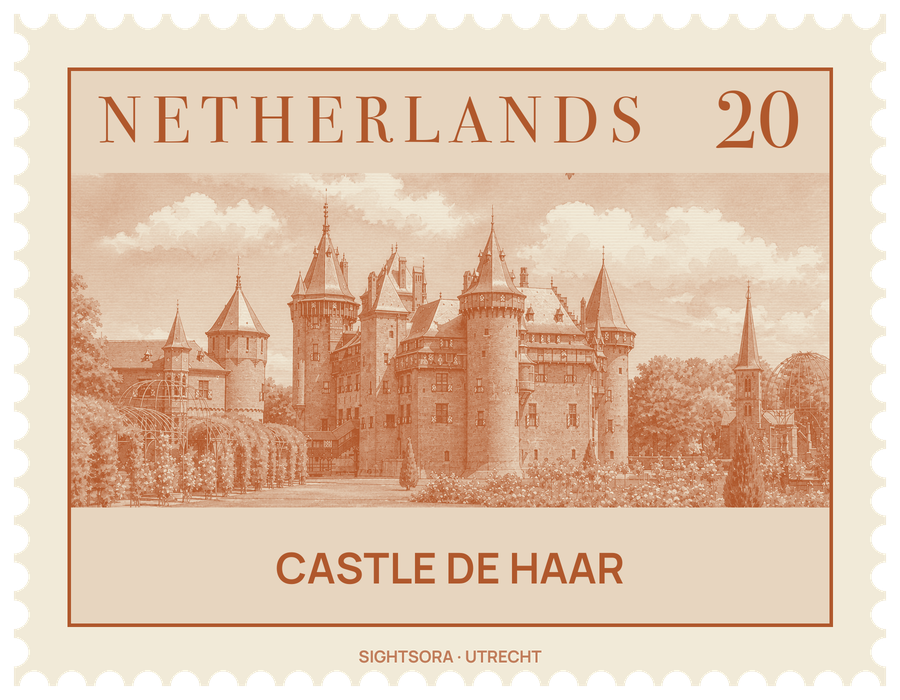
Her family paid for the whole project. Inside are 200 rooms and 30 bathrooms, but visitors see just a handful of them, on the lower two floors.
A building on this spot is first recorded in 1391, when Hendrik van Woerden granted it, with the surrounding land, to the De Haar family as a fief. It passed to the Van Zuylen family in 1440, was burned in 1482, and was rebuilt in the early 16th century; the oldest picture of it, from 1554, shows it largely restored. After 1641 it slowly fell into ruin, and it was this ruin that Etienne inherited in 1890. Cuypers marked the line between old and new masonry by using different bricks, and in the first-floor gallery he placed a statue of himself, tucked into a corner.
For its time the castle was fitted out with the most modern equipment of the day: electric light powered by its own generator and steam central heating, an installation now recognised as an industrial monument. The kitchen keeps its copper pots and pans and a furnace about 6 metres long that burned peat or coal, and its tiles, baked specially in Franeker, carry the arms of the De Haar and Van Zuylen families. The interior is lined with richly carved woodwork that recalls a Roman Catholic church, made in Cuypers's workshop in Roermond. Rothschild touches appear throughout, from the Stars of David decorating the knight's hall balconies to the family arms on the library hearth, while the Van Zuylen motto, A majoribus et virtute, is carved on the knight's hall hearth. Among the furnishings from the Rothschild collections are old porcelain from Japan and China, Flemish tapestries and the carrier coach of a Japanese shōgun's wife.
The park was designed by Hendrik Copijn, and Van Zuylen had 7,000 mature trees brought in for it; since they could not be carried through the city of Utrecht, he bought a house in the way and had it demolished. The grounds have many waterworks and a formal garden modelled on the French gardens of Versailles. To make room for the park, the old village of Haarzuilens was cleared except for its church, and its people were moved a kilometre away to a new village in a pseudo-medieval style, designed mostly by Cuypers and his son Joseph; its houses still carry the red and white colours of the Van Zuylen arms. Since 2000 the castle and its 45 hectares of gardens have belonged to the Kasteel de Haar foundation, and the castle grounds are regularly used for fairs such as the Elf Fantasy Fair.