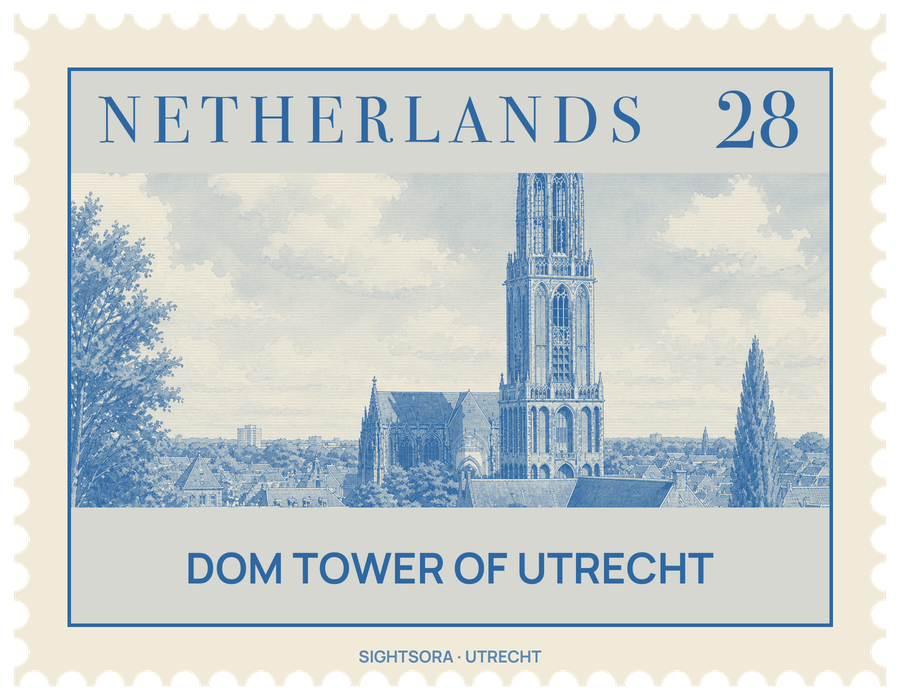
John of Hainaut drew up the design, and the tower rose from 1321 to 1382 as part of St. Martin's Cathedral, the Dom Church. Money ran out before the cathedral was finished, and on the night of 1 August 1674 a tornado brought down the incomplete nave while the tower survived; since then tower and church have stood apart, and coloured paving on the square marks the outline of the lost section.
The design is two square blocks crowned by a much lighter open lantern, with no buttresses in sight. When it was completed in 1382 it was 109 metres tall, and restoration work in 1910 added to its height. Not everyone admired it: the preacher Geert Groote objected that the project was vain, too tall and too costly. The tower served several purposes at once, holding bells, a first-floor chapel reserved for the Bishop of Utrecht and quarters for the tower guard who kept watch over the city. A storm in 1836 badly damaged the top floor, and demolition was seriously discussed before a restoration that took five years.
Bells are a large part of a visit. Fourteen ringing bells weighing 32 tonnes together hang in the tower; Geert van Wou cast a peal of thirteen in 1505, the largest of which, Salvator, weighs 8 tonnes, and members of the Utrecht Bellringers Guild still ring them by hand. Above them is a carillon, installed in 1664 with bells by the brothers Pieter and François Hemony and extended to 50 bells in 1972; the musician Jacob van Eyck became its player in 1625, when the tower still had an earlier set of chimes.
Guided tours lead visitors up the 465 steps to the top, from where both Amsterdam and Rotterdam can be seen on a clear day. Each King's Night brings red, white and blue light to the tower, while the lantern at the top glows orange like a crown.