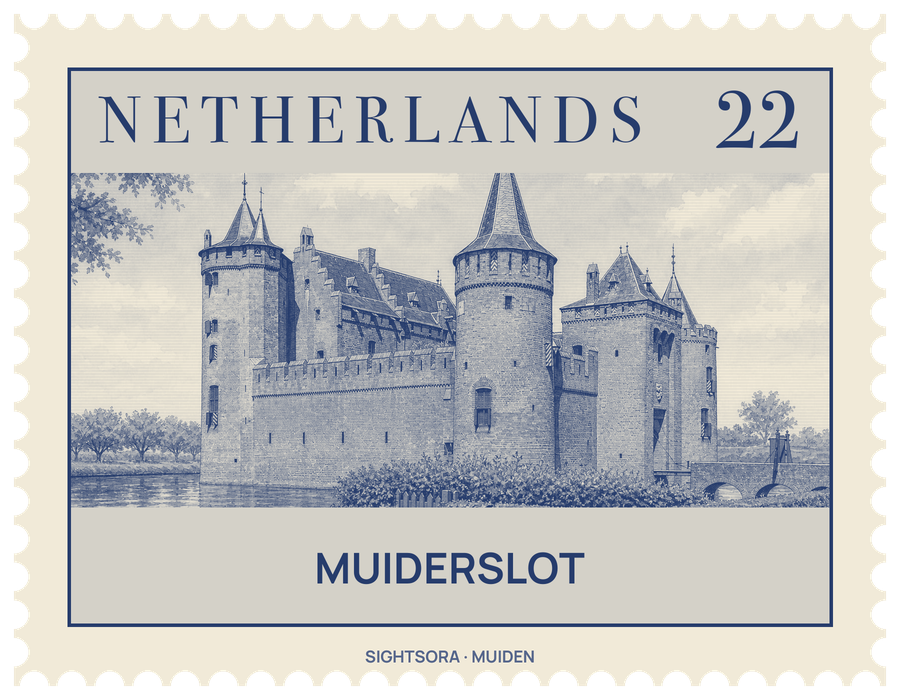
Count Floris V had the first stone castle built here in the late thirteenth century to collect tolls from merchants, because the Vecht was the trade route to Utrecht. The building is small, 32 by 35 metres, but its walls are more than 1.5 metres thick.
Its early history is violent. In 1296 a group of nobles including Gerard van Velsen and Gijsbrecht IV of Amstel seized Floris V and held him prisoner in the castle; when he tried to escape, Gerard van Velsen killed him on 27 June 1296. The Archbishop of Utrecht captured the castle in 1297 and had it pulled down by 1300. Between about 1370 and 1386 Albert I, Duke of Bavaria and Count of Holland and Zeeland, rebuilt it on the same spot and to the same plan.
The castle's best-known resident was the poet and historian Hooft (1581-1647), who served as bailiff of Het Gooiland. He spent 39 summers at the Muiderslot and filled it with guests: the poets Vondel and Bredero, Huygens, Maria Tesselschade Visscher and others, a circle remembered as the Muiderkring. Hooft also enlarged the garden and the plum orchard while earthwork defences were laid out around the castle.
After serving as a prison at the end of the eighteenth century, the castle was left to decay and in 1825 was put up for sale to be demolished; King William I stepped in to save it, and decades of fundraising later paid for its restoration. Today the Muiderslot is a national museum. Its rooms and kitchens have been returned to their seventeenth-century appearance, several rooms display arms and armour, and visitors can see a celestial globe once used for navigating by the stars. The towers once looked out over the sea, and the gardens are planted with forgotten vegetables and herbs.