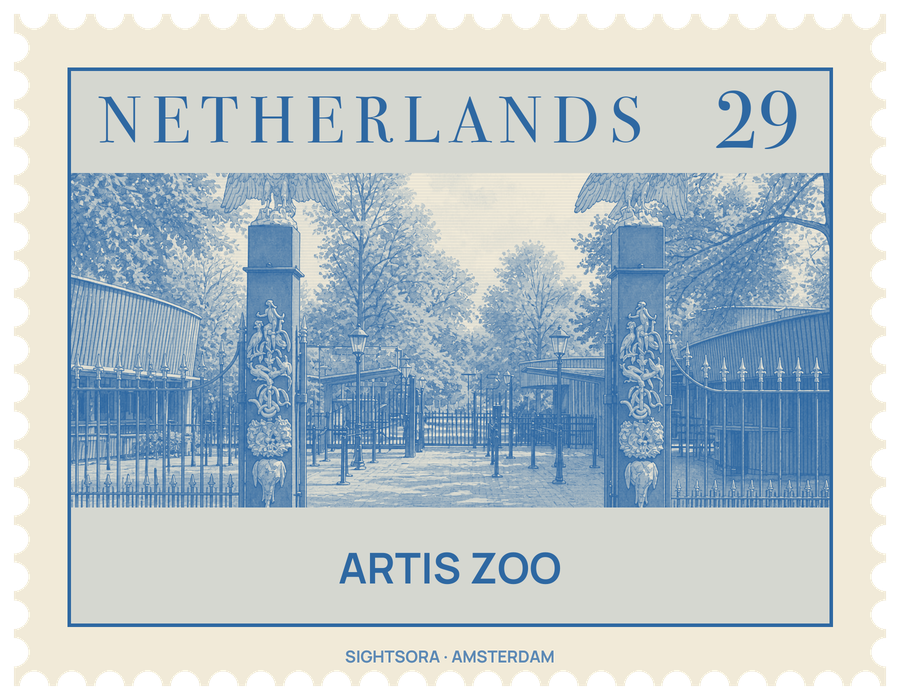
Its full name, Natura Artis Magistra, means in Latin that Nature teaches art, and the zoo has always had more than animal enclosures: today the site combines ARTIS-Park, with its animals, plants and Planetarium, the microbe museum ARTIS-Micropia, the interactive nature museum ARTIS-Groote Museum, an aquarium and an arboretum.
Three zoology enthusiasts, Gerard Westerman among them, founded the zoo in 1838 and bought the Middenhof estate in the Plantage, at that time a thinly populated district on the edge of the city. Entry was at first for members only; from 1851 the public was admitted in September, and from 1920 all year round. The short name comes from the entrance, where three gates carried the words Natura, Artis and Magistra; usually only the middle one was open, so most people simply called the zoo Artis. The last quagga in captivity died here on 12 August 1883, though because all zebras were then called quaggas, no one realised it until years later.
More than two dozen of the buildings, bridges and ponds are protected monuments, and many still house animals. The aquarium dates from 1882 and has the Heimans diorama of 1926 at its back, as well as Deep seeing currents, a permanent installation by the artist Olafur Eliasson that uses darkness, ocean sounds, vibration and light. The wolf house, once an inn, and the Masman Garden House, now home to scarlet ibis, were already standing before the zoo was founded.
Artis also keeps a historical library devoted to botany and zoology, in a building dating from 1867, that combines its own holdings with the libraries of the Amsterdam Botanical Garden and the Zoological Museum Amsterdam. Its shelves hold 80,000 animal prints, 3000 manuscripts and some 20,000 books, along with the archive of Hugo de Vries, and the University of Amsterdam counts it among its special collections.