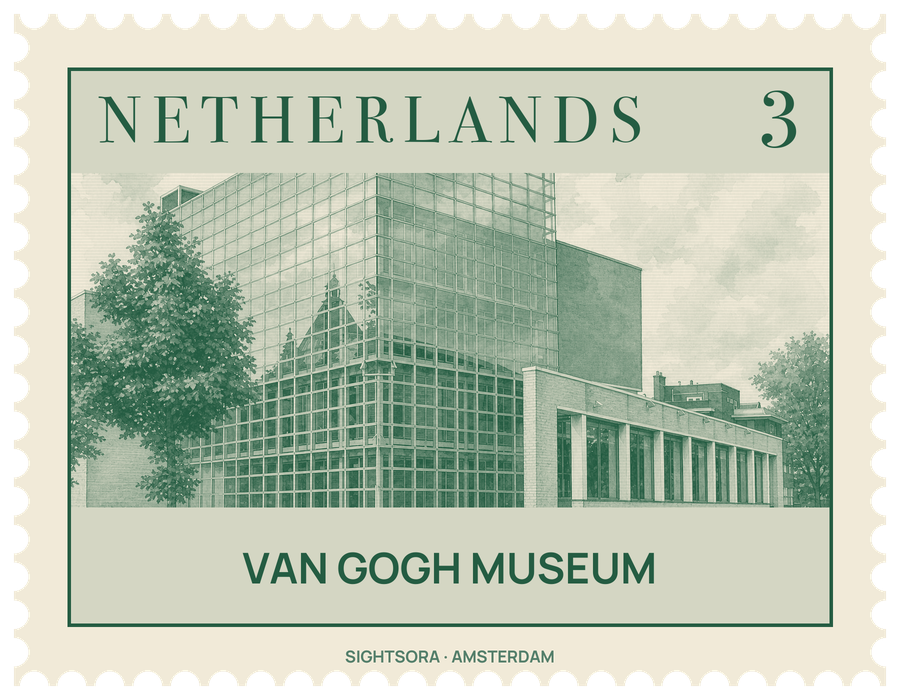
Its address is on the Paulus Potterstraat, with the Rijksmuseum and the Stedelijk Museum on either side and the Concertgebouw nearby, and opened on 2 June 1973. Among the works in the permanent display are The Potato Eaters, Sunflowers and Almond Blossoms.
The collection stayed in the painter's family for decades. When Vincent died in 1890, the unsold works passed to his brother Theo, who died six months later and left them to his widow, Johanna van Gogh-Bonger. She sold many paintings to spread his reputation, organised exhibitions in the Netherlands and abroad and kept a private collection, which her son Vincent Willem van Gogh inherited in 1925. It hung on loan at the Stedelijk Museum for years before passing in 1962 to the Vincent van Gogh Foundation, set up at the state's initiative. The Dutch government asked Gerrit Rietveld to design a museum in 1963; Rietveld died in the following year, and work on the building dragged on until 1973.
Two connected buildings make up the museum. The Rietveld building, rectangular and four storeys high, holds the permanent collection: a shop, a café and an introductory display on the ground floor, Van Gogh's work arranged in date order on the first floor, a floor on the restoration of paintings with room for small exhibitions, and a top floor where his contemporaries hang in relation to his own work. The oval Kurokawa wing, designed by the Japanese architect Kisho Kurokawa and added in 1998 and 1999, hosts the large temporary exhibitions and is reached by a tunnel from the Rietveld building.
The main display follows Van Gogh from place to place: his early work from Nuenen, such as Avenue of Poplars in Autumn; the Antwerp Skull of a Skeleton with Burning Cigarette; the Paris years, with Wheat Field with a Lark and the view from his room in the Rue Lepic; Arles and The Zouave; Almond Blossoms from Saint-Rémy; and Wheatfield with Crows, painted at Auvers-sur-Oise in 1890. Nine self-portraits and paintings from as early as 1882 are in the collection, and the museum also explores what Van Gogh took from Japanese prints. In 2013 it presented Sunset at Montmajour, a canvas that had lain for years in a Norwegian attic and that Van Gogh himself described in a letter to Theo, dating it to 4 July 1888.
Impressionist and Post-Impressionist art by his contemporaries fills out the picture: paintings by Paul Gauguin, Claude Monet, Édouard Manet, Georges Seurat, Paul Signac, Henri de Toulouse-Lautrec, Émile Bernard and Odilon Redon, and sculpture by Auguste Rodin and Jules Dalou. The museum has twice been the target of thieves.