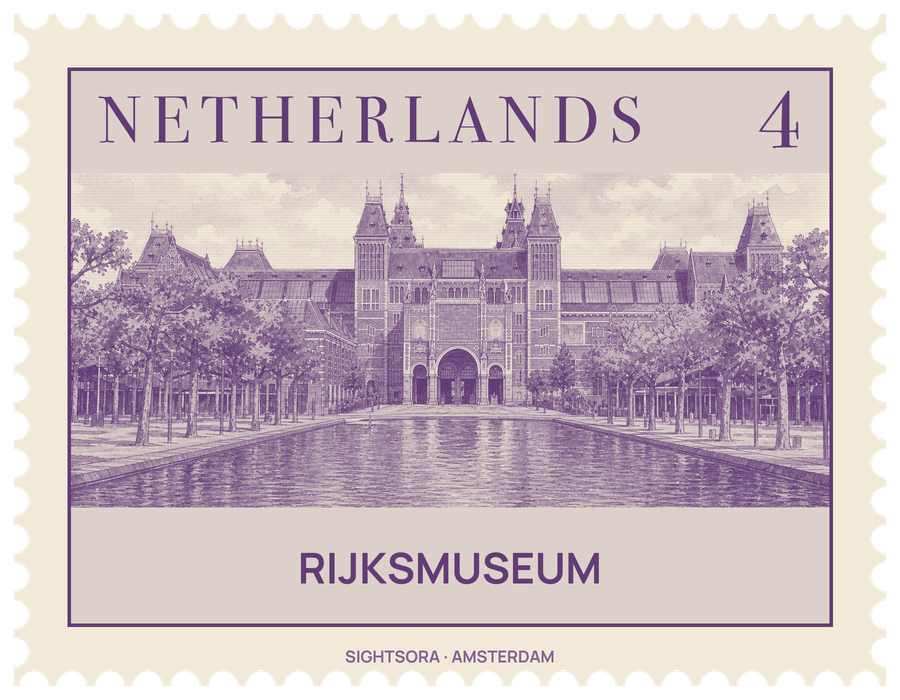
Its building by Pierre Cuypers stands on the Museum Square in Amsterdam South, near the Van Gogh Museum, the Stedelijk Museum and the Concertgebouw, and opened in 1885. The collection runs to one million objects of art, craft and history dating from 1200 to 2000, of which only a small share is on show at any time.
The museum began in The Hague: the government of the Batavian Republic decided to found it on 19 November 1798, and in 1800 a National Art Gallery of around 200 paintings and objects from the stadholders' collections opened in the Huis ten Bosch palace. On the orders of King Louis Bonaparte it moved to Amsterdam in 1808, where paintings owned by the city, The Night Watch among them, joined the collection; it was housed in the Royal Palace and then in the Trippenhuis, which proved too small. Unlike many national museums it did not grow out of a royal collection but was built up over two centuries through purchases and gifts.
Cuypers won the design contest of 1876 with a building that mixes Gothic and Renaissance forms, decorated inside and out with references to Dutch art history in sculpture, tile panels, paintings and stained glass. It is laid out as two squares, each around an atrium, with a passage through the middle at ground level, used by cyclists as well as pedestrians, and the Gallery of Honour above it on the first floor. Between 2003 and 2013 the main building was restored to a design by the Spanish architects Antonio Cruz and Antonio Ortiz, who brought back many of the old interior decorations and cleared the courtyards; Queen Beatrix reopened it on 13 April 2013.
The Gallery of Honour leads to the Night Watch Room, where Rembrandt's painting of 1642 hangs at the end of the hall. The Golden Age collection holds more than 2,000 paintings, by Rembrandt and his pupils, Frans Hals, Johannes Vermeer, Jan Steen and Jacob van Ruisdael among others; Vermeer's The Milkmaid and Rembrandt's The Jewish Bride and Syndics of the Drapers' Guild belong to it. Among the less expected pieces are the Hartog plate, a Bantam biplane and the royal coat of arms taken from HMS Royal Charles, a ship seized in the Raid on the Medway, and a separate Asian pavilion, opened in 2013, shows the museum's small Asian collection.
South-west of the main building stands the Philips Wing, known informally as the fragment building because it was put together in 1890 from pieces of demolished buildings and so gives an overview of Dutch architecture; it hosts exhibitions and the restaurant Rijks. The building also contains the Rijksmuseum Research Library. Through its Rijksstudio platform the museum has put hundreds of thousands of high-resolution images of its works online, free to download and reuse.