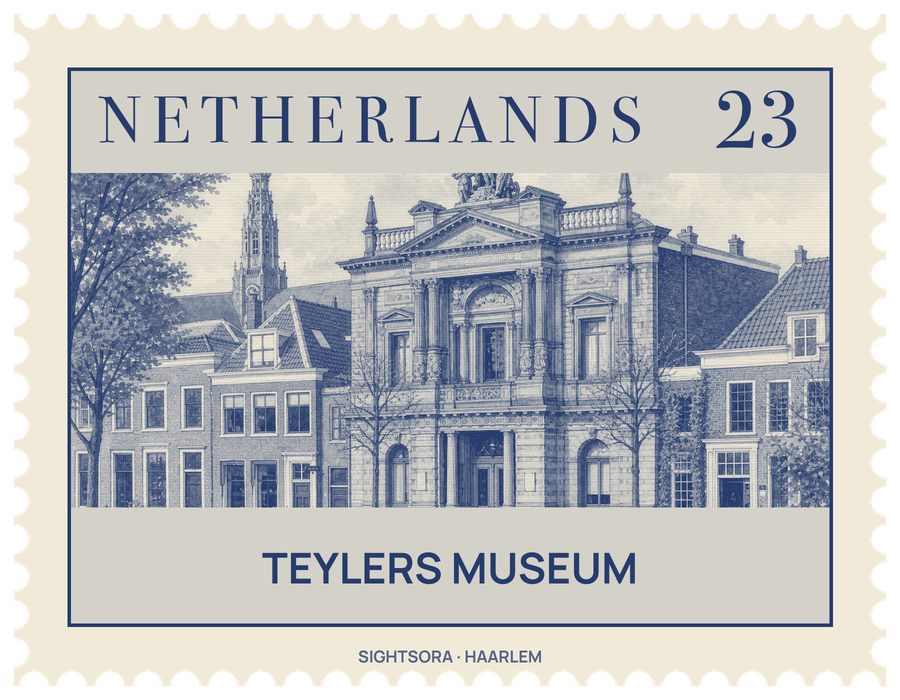
It grew out of the will of Pieter Teyler van der Hulst, who lived from 1702 to 1778, a rich banker and cloth trader of Scottish descent who belonged to the Mennonites, who left his fortune to advance religion, art and science. His executors chose to build a place of study and education where books, instruments, drawings, fossils and minerals could be kept together, inspired by the Enlightenment idea that people could explore the world for themselves.
The oldest part is the neoclassical Oval Room behind Teyler's house, the Fundatiehuis. Leendert Viervant began designing it in 1779 as a room for research, experiments, public demonstrations and the viewing of books and prints, and it opened in 1784 with Martin van Marum as the first director. A central showcase holds an 18th-century mineral collection, the cases around it display 18th-century instruments, and the gallery above, built to catch as much light as possible, has 12 bookcases filled mostly with encyclopaedias and periodicals of the period. Visitors can also explore Pieter Teylers Huis, his former home.
The museum grew in stages, and each new part kept the arrangement of its own day. Painting galleries followed in 1838 and 1892, and the present main entrance on the Spaarne, designed by the Viennese architect Christian Ulrich, opened in 1885; behind it lie the Instrument Room and two fossil rooms, all designed by A. van der Steur, an architect from Haarlem. A large new wing by Hubert-Jan Henket was added in 1996.
Van Marum used the collection for his own research on static electricity and bought fossils such as the Mosasaurus; the large electrostatic generator that John Cuthbertson built for him in 1784 is still part of the collection, along with models of mills and cranes made to demonstrate hydraulics. Among the fossils are some of the first Archaeopteryx specimens ever found. Hendrik Lorentz, a physicist and Nobel Prize winner, looked after of the physics cabinet from 1910 until 1928.
On the art side, the museum holds works by Raphael, Michelangelo, Claude Lorrain and Guercino, and prints by Adriaen van Ostade and Rembrandt. Its painting galleries are devoted to Dutch Romantic painting and to the Hague and Amsterdam Schools that followed it, with paintings by Barend Cornelis Koekkoek, Andreas Schelfhout, Hendrik Willem Mesdag, Anton Mauve, Jacob Maris, George Hendrik Breitner and Jozef Israëls.