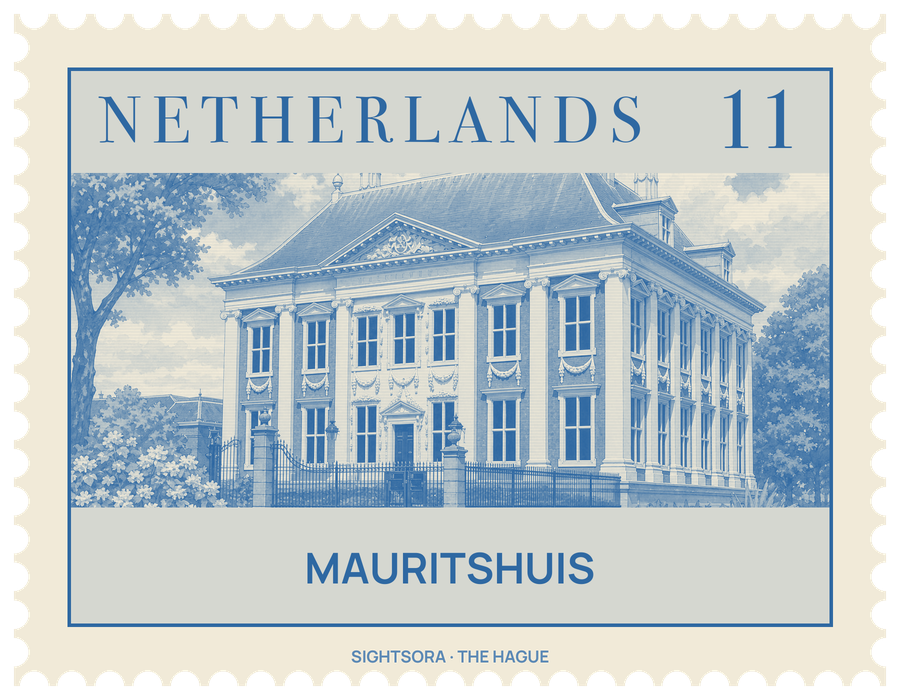
The house went up between 1636 and 1641 for John Maurice of Nassau, a cousin of Stadtholder Frederick Henry, during the years he governed Dutch Brazil. Jacob van Campen and Pieter Post designed it in the Dutch Classicist style, and inside it was divided into four apartments and a great hall.
Its life as a museum began in stages. A fire in 1704 gutted most of the interior and took the original cupola, and restoration work ran from 1708 to 1718. The Dutch state bought it in 1820 to house the royal paintings, opened it to the public in 1822, and from 1875 gave the whole building over to pictures. The core of the collection is the group of paintings that had belonged to stadtholder William V, presented to the state by his son, King William I. During the German occupation the works, Girl with a Pearl Earring among them, were first kept in a bombproof bunker beneath the museum and then moved to the St Pietersberg caves outside Maastricht, where they stayed until May 1945.
Among the best-known pictures here are two by Johannes Vermeer, Girl with a Pearl Earring and View of Delft. Rembrandt is represented by The Anatomy Lesson of Dr. Nicolaes Tulp and by a self-portrait from 1669, and the museum puts its group of Rembrandts at the centre of its story alongside the Vermeers. Other works people come to find include The Goldfinch, dated 1654, and The Young Bull by Paulus Potter, painted in 1647, along with landscapes by Jacob van Ruisdael. Flemish painting is present too, with Rubens, Brueghel and Rogier van der Weyden, as well as portraits by Hans Holbein the Younger.
Between 2012 and 2014 the museum was enlarged to a design by Hans van Heeswijk. It took over part of the neighbouring Sociëteit de Witte building and linked the two with a passage running under the Korte Vijverberg, and King Willem-Alexander reopened it on 27 June 2014. The same organisation also runs the Prince William V Gallery, where a public picture gallery was first set up in 1774. The museum has published its own account of how John Maurice took part in the slave trade while governing Dutch Brazil and how that trade built the wealth behind his house.