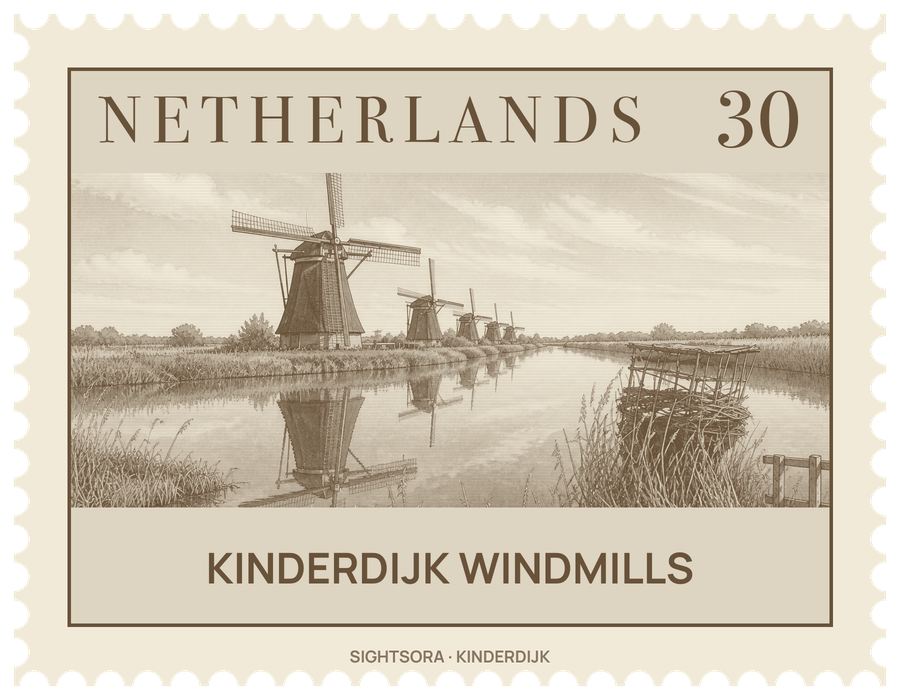
Most of them were built in 1738 and 1740 to pump water out of land lying below the level of the rivers, and they show how the Dutch have kept this low ground dry for centuries. The mills are national monuments, the whole area has been a protected village view since 1993, and in 1997 UNESCO added it to the World Heritage list as the Mill Network at Kinderdijk-Elshout.
Trouble with water in the Alblasserwaard became serious in the 13th century. Large drainage canals, the weteringen, carried off the excess, but the drained soil kept sinking while sand deposits raised the river. The mills could not lift water all the way to the river, so they pumped it into reservoirs at a middle level; locks then released the reservoirs into the river at times of low water, which depended on the tides and the seasons.
There are two main rows. The eight brick mills of the Nederwaard, from 1738, drained the lower polders, and the eight wooden, octagonal mills of the Overwaard, from 1740, drained the higher ones; the Kleine of Lage Molen of 1761 and De Blokker, which belongs to Alblasserdam, complete the group. In the nineteenth century steam pumping stations took over much of the work, and after World War II, when a fuel shortage had briefly put the mills back into service, they were all taken out of use. Plans by the Overwaard water board to demolish its mills met with opposition that reached national politics, and the first museum mill opened in the 1950s.
The mills are still kept in working order, but the real work of controlling the water has passed to a pair of electric pumping stations by one of the site's entrances. Visitors can follow walking and cycling paths or take a boat past the mills, step inside some of them and meet the millers, and visit an exhibition and the Wisboom pumping station. The site is run by a non-profit organisation with more than 270 volunteers, and ticket income goes towards maintaining the windmills and the landscape.