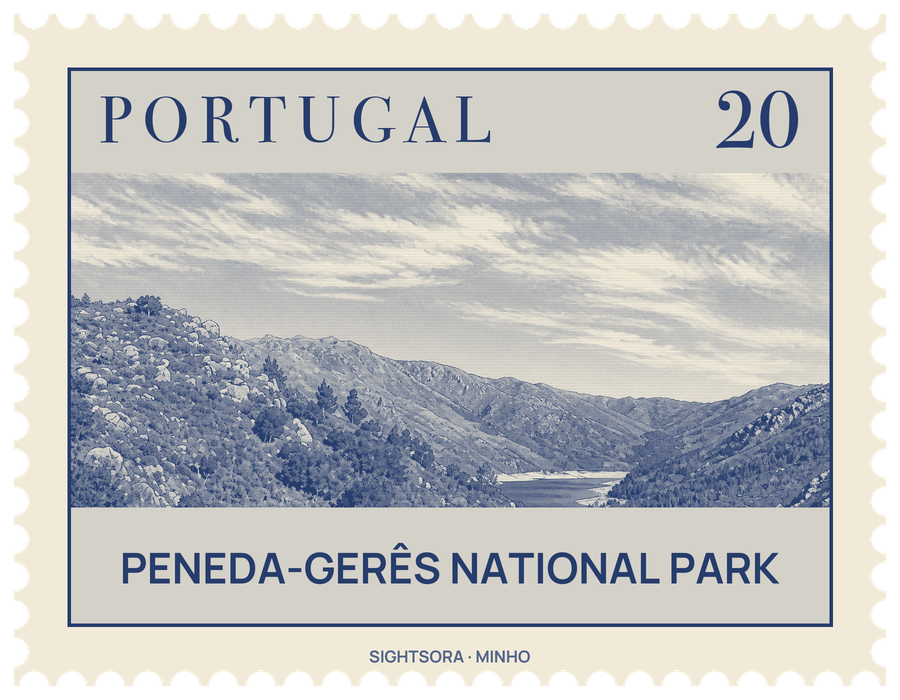
Its name joins those of its two main granite ranges, Peneda and Gerês; these two, along with the Soajo and Amarela ranges, hold the park's highest ground; Gerês reaches 1545 m and Altar dos Cabrões, on the border with Galicia, 1,538 m. The park was created in May 1971. Across the border to the north lies Spain's Baixa Limia – Serra do Xurés park, and the two together make up the Gerês-Xurés UNESCO biosphere reserve.
The landscape is shaped like a vast amphitheatre. Ice Age glaciers left U-shaped valleys, moraines and polished granite in the Peneda, Soajo and Gerês ranges, and deep, straight valleys carry the rivers of the Lima and Cávado basins, with brooks and waterfalls on many slopes. Atlantic weather meets the mountains here, bringing heavy rain through the year and more than 130 rainy days; the high ground stays cool, while the Homem, Lima and Cávado valleys are much warmer. Steep valleys hold oak and pine woods, among the last places in Portugal with typical Atlantic European flora.
Wildlife includes roe deer, the symbol of the park, along with wild boar, the European otter, the Pyrenean desman, the gold-striped salamander and the Iberian frog. Half-wild Garrano horses, a small and gentle local breed, roam freely, and Spanish ibex coming from Galicia have reoccupied the niche left by the Gerês goat, a local ibex last seen in the 1890s. The Iberian wolf survives in small numbers. Local Barrosã cattle, with long curved horns, graze traditional pastures, and the Barroso agro-sylvo-pastoral system within the park was among the first European sites named a Globally Important Agricultural Heritage System in 2018.
People have lived in these mountains for a long time. Dolmens and other megalithic tombs survive near Castro Laboreiro and Mourela, and the Roman Geira, the road that linked Asturica Augusta with Braccara Augusta, still runs for long stretches along the Homem River with Roman bridges and milestones. In isolated mountain villages like Ermida and Pitões das Júnias, people keep terraced fields and granite houses with thatched roofs, and families around Castro Laboreiro traditionally moved between a summer home high in the hills, the branda, and a winter home in the valley, the inverneira.
About 9,000 people live in small villages within the park, and tourism is kept deliberately small-scale, with six small camping sites and several marked hiking trails leading to sights like the monastery of Pitões das Júnias and the hill-forts, or castros, of Calcedónia and Castro Laboreiro. Many popular stops lie near the main roads: the pilgrimage shrines of São Bento da Porta Aberta and Senhora da Peneda, and the villages of Soajo and Lindoso with their espigueiros, small granite granaries on stilts. In Soajo, a group of 24 shares a single granite slab, and villagers still dry their corn in them. Waterfalls draw many visitors, including one near the old border post at Portela do Homem and the cascades of the Arado river. In dry years, the ruins of Vilarinho das Furnas, a village flooded by a dam on the Homem River in 1970, rise above the water.