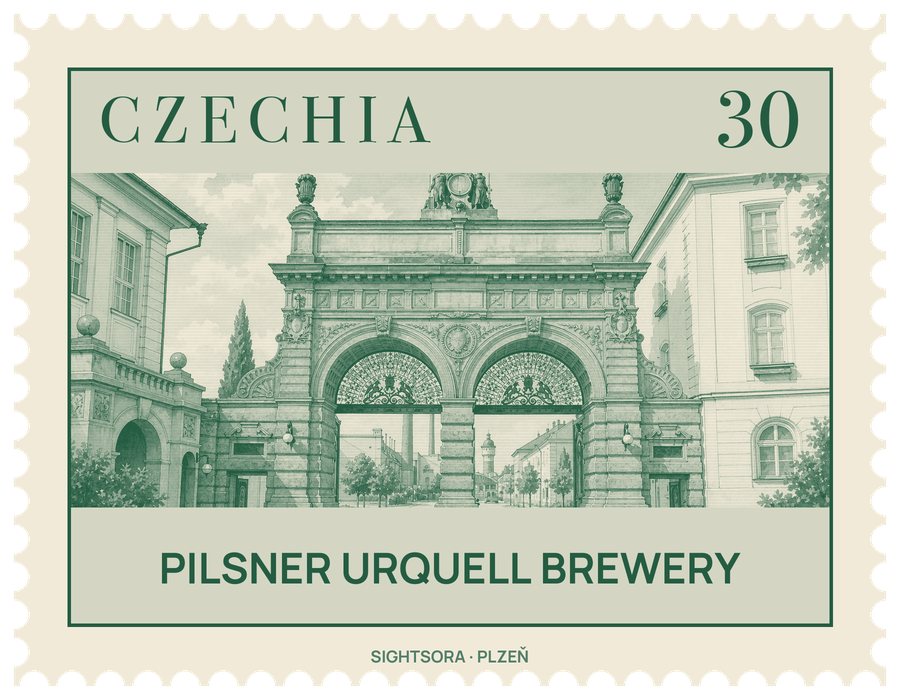
Both Czech-speaking and German-speaking burghers took part in founding it in 1839 as the Bürgerbrauerei, in Czech Měšťanský pivovar, and the Bavarian brewer Josef Groll made the first bottom-fermented batch. The company, today called Plzeňský Prazdroj, still brews Pilsner Urquell on the same site and offers tours of the brewery.
The beer's name grew out of the rivalry its success created. "Pilsner Bier" was registered as a brand at the Plzeň Chamber of Commerce and Trade on 1 March 1859, and in 1898 the brewery adopted the German trademark Urquell and the Czech Prazdroj, both roughly meaning "original source", to press its claim to be the place where pilsner began. The beer has kept its recipe and its traditional methods, among them triple decoction and lagering in wooden barrels.
Beer was made in Plzeň long before the brewery existed: the city was established in 1295, and a brewery with a malt house is first recorded in 1307. That older story is the subject of the brewery museum, the Pivovarské muzeum, which occupies an authentic medieval brewing house protected as a cultural monument. Visitors walk through the late Gothic malt house, the kiln and the original drying shed, and down into two levels of lagering cellars with an ice cellar, all cut into the rock beneath Plzeň.
The exhibition covers the early history of Plzeň, the rise of crafts and guilds, and the development of brewing, malting, coopering, haulage and catering. Along the way are a reconstructed pub from the end of the 19th century and a brewing laboratory of the later 19th century, and a section of the city walls has been opened up with a display of barley and hops growing. The museum is an anchor point of the European Route of Industrial Heritage.