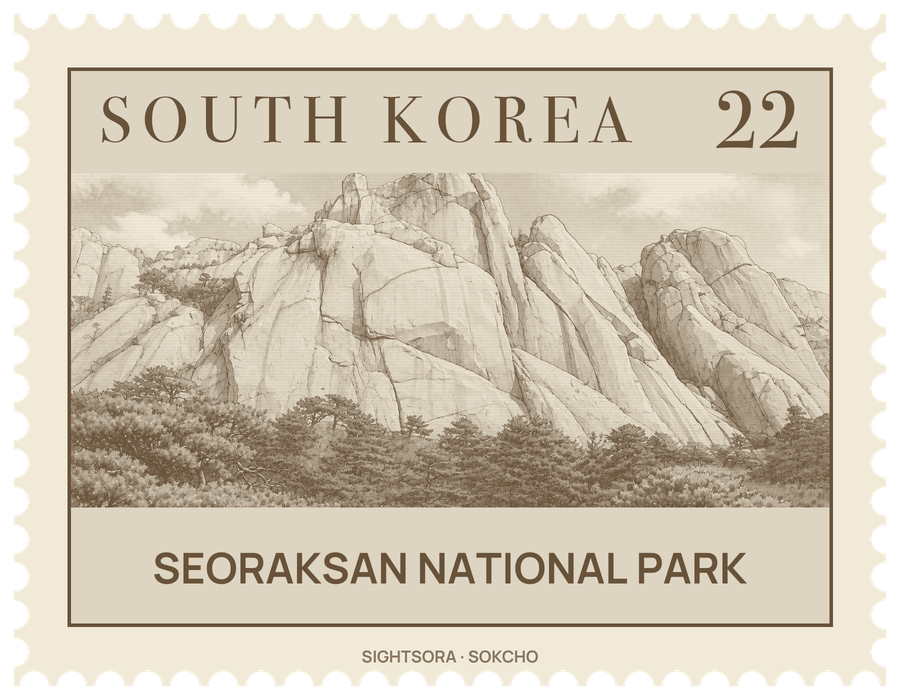
The area was declared Natural Monument No.171 in 1965 and a national park on March 24, 1970, and in 1982 UNESCO made it a biosphere reserve. Its rarer wildlife includes the Asian black bear and the long-tailed goral, both protected as natural monuments.
The park is divided into three parts. Naeseorak, Inner Seorak, lies to the north-west in Inje-gun, with valleys such as Baekdam, Gaya-dong and Gugokdam and the Daeseung Falls. Oeseorak, Outer Seorak, on the Sokcho side to the east, has the easier hiking routes and is among the busiest parts of the park; it also has the Towangseong Waterfall. The third part is Namseorak, South Seorak.
From the main car park in Outer Seorak, the Yukdam and Biryong (Flying Dragon) waterfalls on the southern side of the valley are about a forty-minute walk away. Another path climbs more than 800 steps to Ulsanbawi, a rock formation of unusual shape, passing two temples and Heundeulbawi, a rounded boulder about 5 metres high perched on a larger rock, which visitors can rock a little with some effort but never dislodge. Local legend says Ulsanbawi set out from the city of Ulsan to join Mount Kumgang, arrived too late to find room, and on its way home liked Seorak so much that it stayed. Near the main entrance stands Sinheungsa, a Buddhist temple with a large seated bronze Buddha.
At the end of the main valley, Biseondae is a rock platform in a stream, with a hard-to-reach cave above it that looks out over the surrounding rock formations. A little further from the entrance lies the Valley of a Thousand Buddhas, Cheonbul-dong, the mountain's main valley, named for the rows of rock formations along its sides that resemble Buddha statues.
The Dinosaur Ridge runs from Madeungyeong to Sinseonam, its jagged peaks resembling the spiked back of a dinosaur; it was named a scenic treasure of Korea in 2013. It is a strenuous route: signs in the park give it as a 5 hour hike over 5.1 kilometres, and simply reaching it from Madeungyeong pass or the Huiwoongak shelter is a hard climb, so the full traverse from the eastern entrance can take more than 10 hours. Its remote location, steep slopes and stretches of scrambling make exhaustion a real danger.