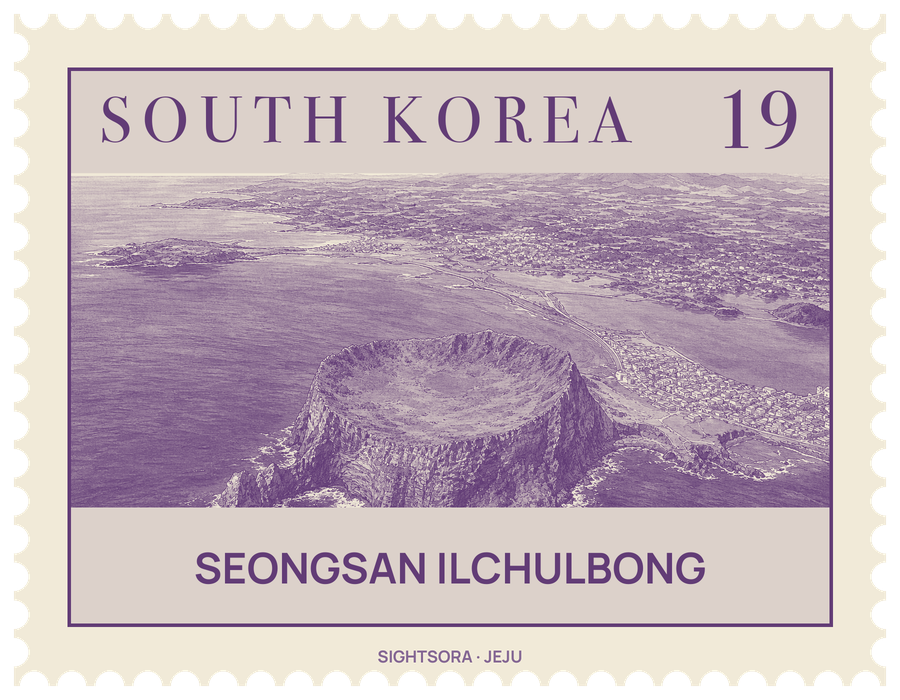
As the easternmost mountain on Jeju it is the island's favourite place to watch the sun come up, above all the first sunrise of the year. It forms part of the UNESCO Natural World Heritage Site Jeju Volcanic Island and Lava Tubes, inscribed on July 2, 2007, and it has been a Natural Monument of South Korea since 2000.
Its two names were once separate. "Seongsan" means fortress mountain, because the peak is said to look like a Korean fortress, while "Ilchulbong", sunrise peak, is an old name drawn from its reputation for sunrise views; some elderly people still call it Cheongsan, the green or blue mountain. Surtseyan-type hydrovolcanic eruptions on a shallow seabed built the cone around 6,700 years ago, and the waves have since cut away much of it, exposing its inner layers along the cliffs. It began as an island of its own until sediment built up and joined it to Jeju.
A wooden deck staircase leads to the top, a climb of up to 30 minutes. The mountain is 600 metres in diameter, and its crater is a smooth, shallow bowl whose floor lies around 90 metres above sea level; from the top the views take in Hallasan, the island of Udo and the open ocean. Some 240 plant taxa have been recorded on the mountain, which volcanologists study closely for its geology. People once raised horses and lived inside the crater, and farmers grew bamboo there in the 20th century, until it became a protected site late in that century.
The flanks of the mountain keep a darker chapter. As World War II drew to a close, the Japanese Imperial navy cut around 18 caves into the sides of the mountain to hide boats packed with explosives, meant to stop an expected Allied landing on Jeju; the caves remain and are listed as Registered Cultural Heritages of South Korea. Visitors can also walk the area around the foot of the mountain.