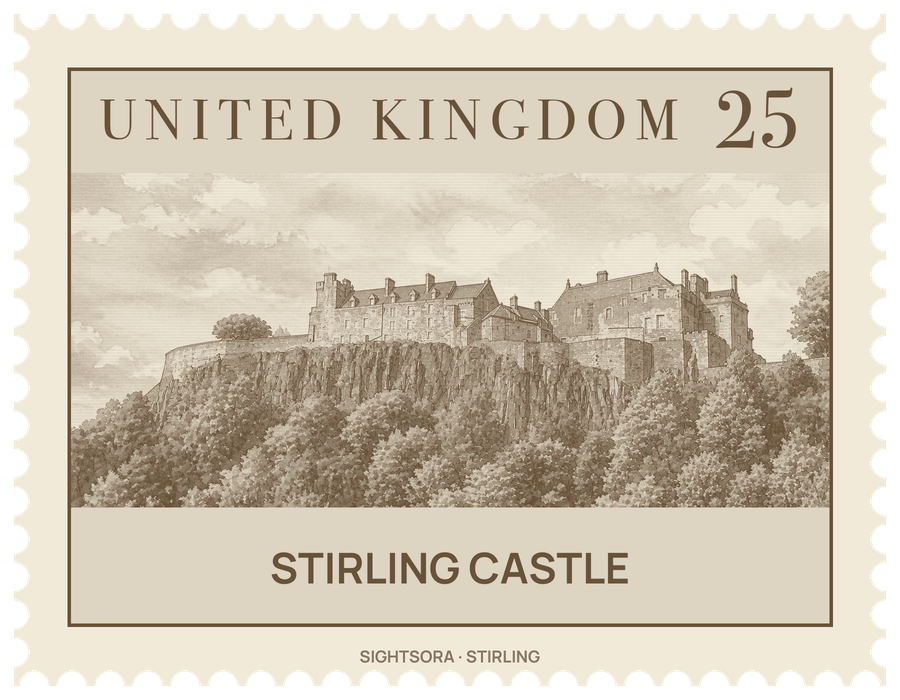
Until the 1890s the rock guarded the last crossing point on the Forth before the sea, which made it a prize in Scotland's wars: it was besieged at least eight times, William Wallace and Andrew Moray won it back after the Battle of Stirling Bridge, and the battle of Bannockburn in 1314 was fought within sight of its walls. The castle is a scheduled monument cared for by Historic Environment Scotland.
What stands today is mostly a Renaissance royal residence. Almost all the main buildings went up between 1490 and 1600, when James IV, James V and later James VI made Stirling one of their chief seats, and the kings and queens who were crowned here include James V and the infant Mary, Queen of Scots, who spent her early childhood in the castle. Visitors pass through the three main enclosures, entering by the gatehouse of James IV's Forework, now much reduced, into the Outer Close and then the Inner Close, around which the principal buildings are grouped.
The Great Hall, which fills the eastern side of the Inner Close, was built by James IV and was already being plastered by 1503; it is 42 metres long and lit by large windows at the dais end where the king sat. After 1800 the army divided it into barrack rooms and removed its hammerbeam roof; the restoration that put back the roof and limewashed the outer walls was completed in 1999. To the south, the Royal Palace begun by James V in the 1530s is covered with carved statues drawn from German sources, among them James V himself, the Devil, St Michael and Venus. Its interiors have been recreated to show the king's and queen's apartments as they may have looked in the 1540s, including newly woven versions of the Hunt of the Unicorn tapestries in the Queen's Presence Chamber; the surviving Stirling Heads, carved oak portrait roundels that once decorated the King's Presence Chamber, are kept in the castle.
Closing the north side of the courtyard, the Chapel Royal was built in 1594 for the baptism of Prince Henry, son of James VI, to designs probably by William Schaw, and later decorated with wall paintings by Valentine Jenkin. On the western side, the King's Old Building of around 1497 holds the regimental museum of the Argyll and Sutherland Highlanders, whose headquarters are in the castle. Below the west wall, the grassy outlines of the King's Knot mark a 16th-century formal garden laid out on the site of a medieval jousting ground.