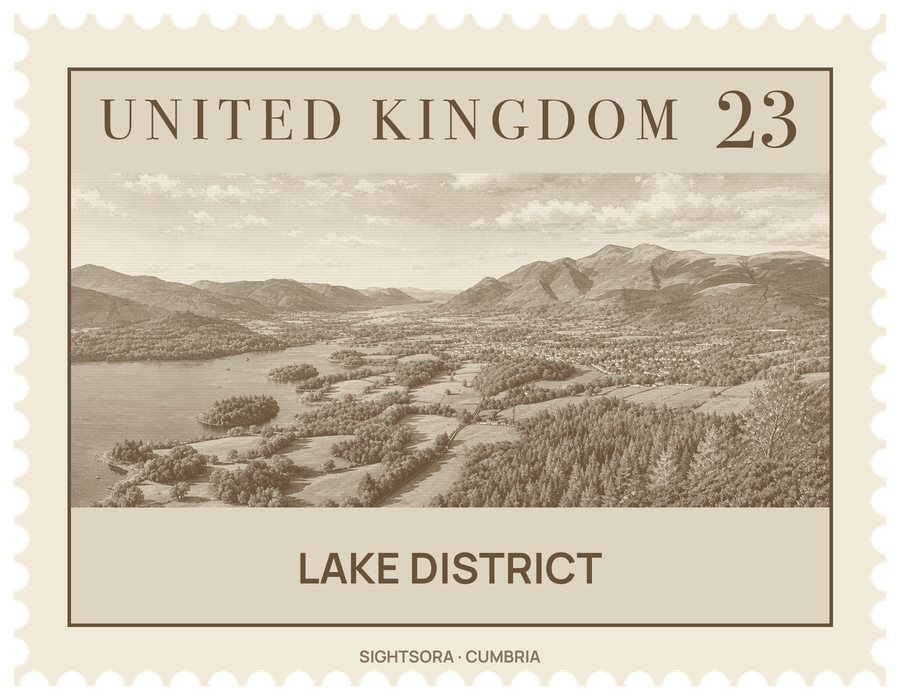
Most of it lies within the Lake District National Park, set up in 1951 and covering about 2,362 square kilometres, and in 2017 the park was inscribed as a UNESCO World Heritage Site for its cultural landscape. The valleys spread out from the centre like the spokes of a wheel, splitting the mountains into separate blocks.
The mountains here are called fells, a word that came from Old Norse. Scafell Pike, at 978 metres, has a view on a clear day that can take in the hills of Galloway in Scotland, the Mourne Mountains, the Isle of Man and Snowdonia; Helvellyn and Skiddaw, the latter 931 metres high, are the other best-known summits. Among the sixteen major lakes are Windermere, 18 kilometres long, Wast Water in the craggy Western Fells, Ullswater, Derwent Water, Coniston Water and Buttermere. Only one of them, Bassenthwaite Lake, actually has "lake" in its name; the rest are meres, tarns and waters.
Much of the landscape was shaped by farming, above all by sheep, and the hardy local Herdwick breed and the dry stone walls that criss-cross the fells are part of what visitors come to see. Red squirrels live in the woods, ospreys first nested near Bassenthwaite Lake in 2001, and the RSPB keeps a reserve at Haweswater. The weather is wet, especially in the west, and hill fog can come down at any time of year, while the fells see only around 2.5 hours of sunshine a day on average; the spring months from March to June are usually the least rainy.
The Lakes have a long literary history. William Wordsworth went to school at Hawkshead and lived at Grasmere and Rydal Mount; he and his wife are buried in Grasmere churchyard, and Dove Cottage & The Wordsworth Museum tells his story. His Guide to the Lakes, first published in 1810, helped draw visitors here, as Alfred Wainwright's hand-drawn guides to 214 fells did for walkers after they appeared between 1955 and 1966. Beatrix Potter lived at Hill Top Farm and set many of her Peter Rabbit books in the area, John Ruskin spent his last years at Brantwood beside Coniston Water, and Arthur Ransome used a fictional Lakeland for five of his Swallows and Amazons books.
Much of the park is best seen on foot: signposted public footpaths and bridleways run all over it, walkers have a general right to roam across about half the park, and the Coast to Coast Walk crosses the park from west to east. The National Park Authority runs a visitor centre in Brockhole, a former country house on Windermere. Keswick, Ambleside and Windermere with Bowness-on-Windermere are the main towns, and Theatre by the Lake in Keswick and festivals such as the Kendal Mountain Festival add to a stay.
Getting there
The M6 motorway runs up the eastern flank of the Lake District, and the A591 leads from Kendal to Windermere and on to Keswick. By rail, the West Coast Main Line passes along the eastern edge, and the Windermere Branch Line runs from Kendal to Windermere via Staveley; the Cumbrian Coast Line skirts the south and west and connects with the narrow-gauge Ravenglass and Eskdale Railway into Eskdale.
On Windermere, the heritage Lakeside and Haverthwaite Railway meets boats at Lakeside that sail up the lake to Bowness, and a car ferry crosses the lake. Seasonal passenger boats also run on Coniston Water, Derwent Water and Ullswater.