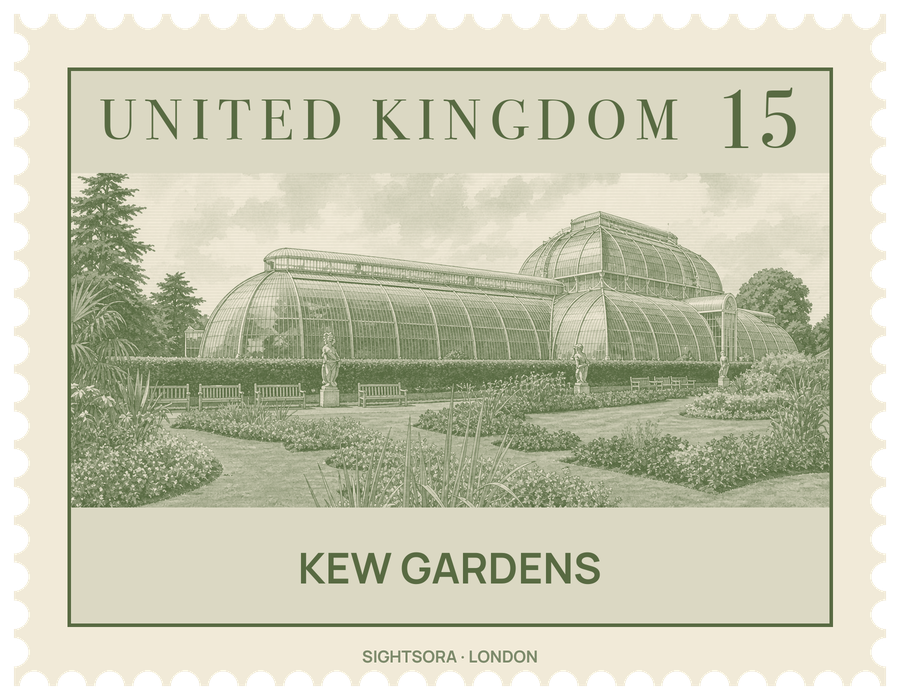
It grew from the royal estates of Kew and Richmond: Augusta, Dowager Princess of Wales, enlarged an exotic garden here, George III added to it with the help of Sir Joseph Banks, and in 1840 it became a national botanic garden. The Royal Botanic Gardens, Kew, which runs it, is a research institution and its herbarium keeps more than 8.5 million dried and preserved specimens of plants and fungi. UNESCO listed the gardens as a World Heritage Site in July 2003.
The great glasshouses are the core of a visit. The Palm House, built between 1844 and 1848 by Decimus Burton and the ironmaker Richard Turner, is a curving frame of wrought iron and hand-blown glass; a walkway 9 metres up runs around its 19-metre central nave, putting visitors level with the palm crowns, and the Queen's Beasts, ten stone animals bearing shields, stand outside its east front. The Temperate House, twice its size and by the same pair, reopened in May 2018 after restoration and gathers plants and trees from temperate climates across the globe, a number of them very rare, with a viewing gallery in its central section. The Princess of Wales Conservatory, opened in 1987, divides its glass into ten climate zones with orchids, cacti, carnivorous plants and water lilies.
Elsewhere, the Treetop Walkway takes visitors on a 200-metre circuit 18 metres up in the canopy of a woodland glade, reached by stairs or a lift; its metal floor flexes underfoot and the structure sways in the wind. The Hive, a 17-metre honeycomb of aluminium set in a wildflower meadow, explores the life of bees, and a curving bridge of black granite and bronze crosses the lake. In the south-east corner rises the Great Pagoda, a 50-metre Chinese-style tower of ten storeys designed by Sir William Chambers and finished in 1762; near it stands the Chokushi-Mon, a gateway copied at four-fifths scale from a temple in Kyoto, inside a Japanese garden.
Kew Palace, a brick house built around 1631 by a Dutch merchant and later bought by George III, has a small garden behind it, the Queen's Garden, planted with species once believed to have healing properties; the palace is run separately by Historic Royal Palaces. The Marianne North Gallery displays 832 paintings of plants by an MP's daughter who travelled alone across the Americas, South Africa and Asia, hung exactly as she arranged them, and the linked Shirley Sherwood Gallery shows botanical art. Volunteers lead walking tours of the gardens, and the Kew Explorer road train makes a circuit with several stops.
Getting there
Kew Gardens station, served by the District line and the London Overground, is about 400 metres along Lichfield Road from Victoria Gate. Kew Bridge station, across the river and 800 metres from Elizabeth Gate, has South Western Railway trains from Waterloo and Clapham Junction. Bus 65 stops near Lion Gate and Victoria Gate, bus 110 near Kew Gardens station, and buses 237 and 267 at Kew Bridge station. The four public entrances are Elizabeth Gate, Brentford Gate, Victoria Gate, where the visitor centre is, and Lion Gate; a car park lies outside Brentford Gate.