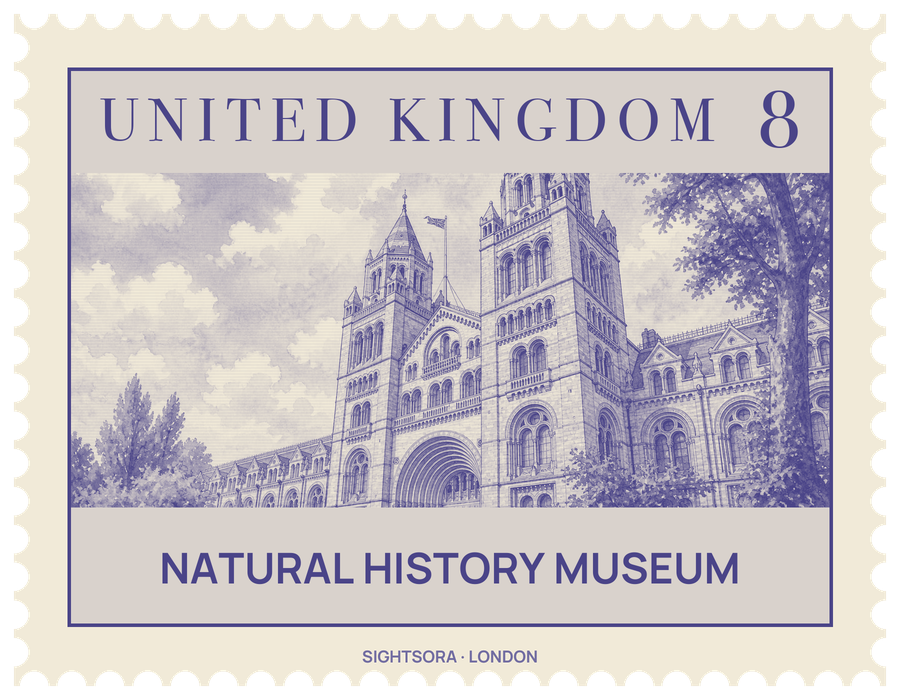
The museum grew out of the natural history collections of the British Museum, which were badly kept and short of space; after the palaeontologist Richard Owen took charge of them in 1856 he pressed for a separate building, construction ran from 1873 to 1880, and it opened on 18 April 1881. Its official name stayed British Museum (Natural History) until 1992.
The building itself is worth a slow look. At Owen's request, living species decorate the west wing and extinct ones the east, though Waterhouse let a few strays cross over, such as bats among the extinct creatures and a fossil ammonite among the living. Visitors entering from Cromwell Road step into Hintze Hall, the great central hall, where the skeleton of a young blue whale nicknamed Hope hangs from the ceiling. It replaced Dippy, the cast of a Diplodocus skeleton that stood in the hall for 112 years until early 2017. The upper floor of the hall holds a cross-section of a giant sequoia that has been at the museum since 1893.
The galleries are grouped into colour-coded zones. The Green Zone, around Hintze Hall, follows the evolution of the planet and includes the marine reptile fossils. The Blue Zone, to the left of the hall, covers the diversity of life, and its Mammals Hall holds a life-sized blue whale model completed in 1938. The Dinosaurs Gallery is home to a roaring animatronic T. rex. The Red Zone, entered from Exhibition Road, deals with the Earth itself; the Earth Hall there displays Sophie, a Stegosaurus skeleton, and Earth's Treasury shows rocks, minerals and gemstones in a dim gallery. Outside, a Diplodocus called Fern stands in the Evolution Garden.
Among the collection's highlights are the first Archaeopteryx specimen ever found, the first complete plesiosaur skeleton, discovered by Mary Anning in 1823, the first complete ichthyosaur skull, found by Joseph Anning in 1811, a dodo skeleton, a Moon rock sample brought back by Apollo 16 in 1972 and a first edition of Darwin's On the Origin of Species. Behind the scenes, the Darwin Centre stores millions of specimens preserved in alcohol, including Archie, a giant squid 8.62 metres long; it is not on general display, but Spirit Collection Tours take visitors into the stores.
Getting there
South Kensington is the nearest Underground station, and a pedestrian tunnel runs from the station and comes out near the doors of this museum and its two neighbours on Exhibition Road. The main entrance is on Cromwell Road, with a second entrance on Exhibition Road; Museum Lane, on the north side, provides disabled access.