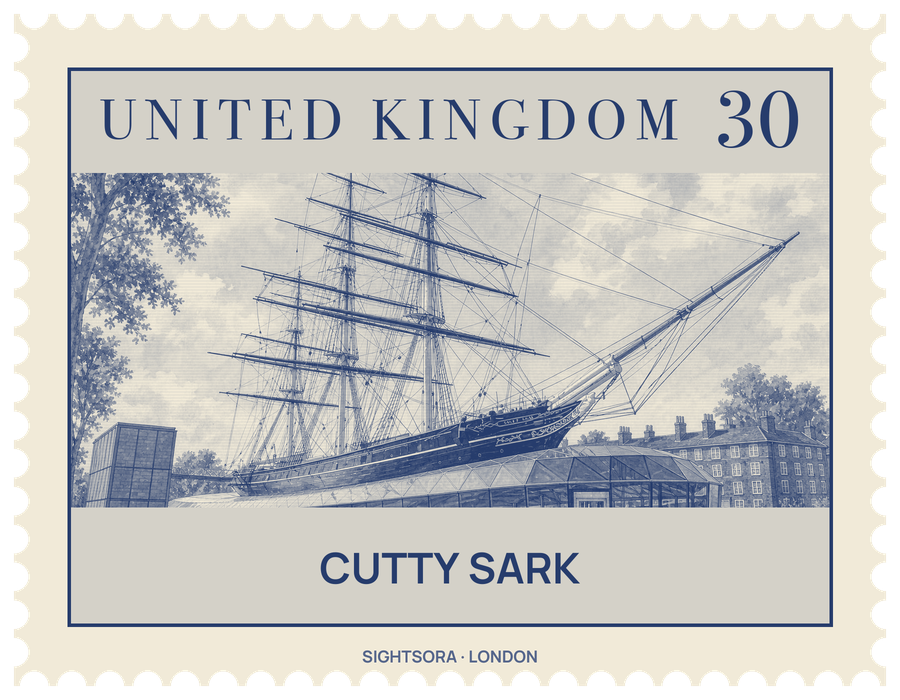
She was launched on the River Leven at Dumbarton in Scotland in November 1869 for the shipowner John Willis, one of the last clippers built for the race to bring each season's tea from China, just as steamships and the new Suez Canal were taking that trade away. Her hull is of the composite type, with timber planking fixed to an iron frame, and she is one of only three intact 19th-century ships built this way.
The ship takes her name from Robert Burns's poem Tam o' Shanter of 1791, in which the witch Nannie Dee, dancing in a cutty sark, a short shift in Scots, chases Tam on his horse and catches its tail. Her figurehead shows the witch with long black hair and a horse's tail in her hand. Cutty Sark sailed eight tea seasons between London and China; in 1872 she raced Thermopylae home from Shanghai and was well ahead when she lost her rudder in a gale, and the carpenter built a new one at sea from spare timber and iron. From the 1880s she carried Australian wool, and under Captain Richard Woodget, appointed in 1885, she made fast passages by sailing far south to find the strong winds of the Roaring Forties.
In 1895 she was sold to a Portuguese firm and renamed Ferreira, and her voyages took her from Portugal to Britain, Angola, Mozambique, New Orleans and Rio de Janeiro. The retired captain Wilfred Dowman bought her in 1922 and used her as a training ship at Falmouth, and she later served the Thames Nautical Training College at Greenhithe. In 1954 she was moved into a purpose-built dry dock at Greenwich to go on public display. A serious fire in May 2007, during conservation work, damaged the middle of the ship, but much of her original fabric had already been removed for the work, and she was restored and reopened on 25 April 2012.
In the restoration the ship was raised about three metres on steel supports, so that visitors can walk beneath the copper-sheathed hull as well as climb aboard; they enter through an opening cut in the hull below the waterline into the lower hold, and a glass lift runs up to the weather deck. The space under the ship holds a collection of ships' figureheads and the Cutty Sark Café. An audio guide can be played on a phone while exploring, and volunteer explainers on board tell the ship's story.
Getting there
The ship is a minute's walk from the Docklands Light Railway's Cutty Sark station, with connections to central London and the Underground. Scheduled river boats from central London call at Greenwich Pier, right beside the ship.