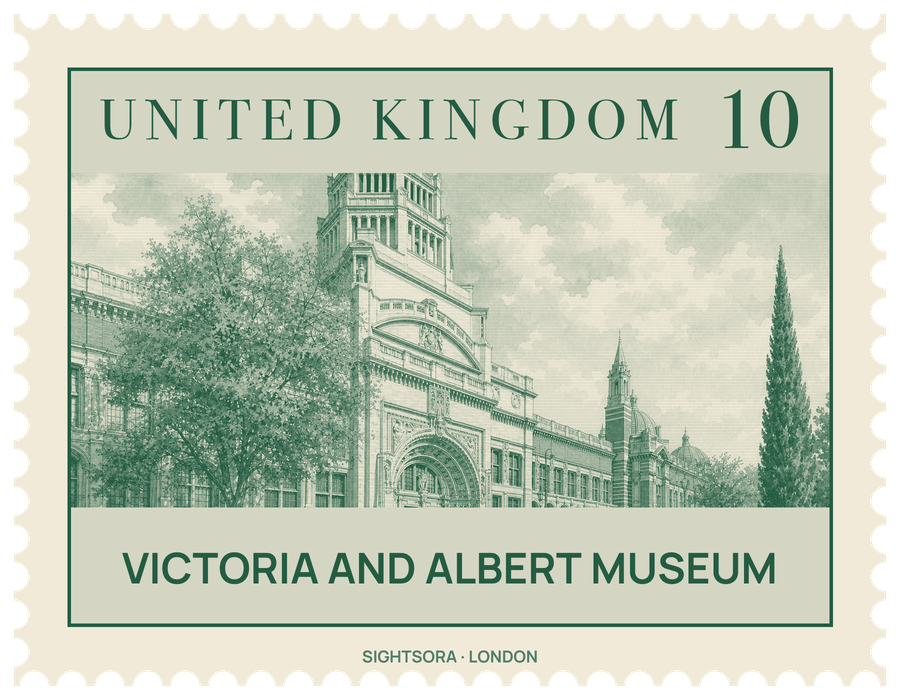
Its main London building has over 145 galleries. The museum began as the Government School of Design, set up in 1832 to raise the standard of British manufacturing, and after the Great Exhibition of 1851 Henry Cole and Prince Albert turned its collection into a public museum. Queen Victoria opened it in South Kensington on 20 June 1857, and in 1899, when she laid the foundation stone of the new front, it took its present name.
That front, built in red brick and Portland stone between 1899 and 1909 to designs by Aston Webb, runs for 220 metres along Cromwell Gardens; above the entrance a tower is crowned by a statue of Fame, with figures of Prince Albert and Queen Victoria in the arches over the doors. Behind it, older Victorian buildings form a quadrangle around a central garden. On the Exhibition Road side, a courtyard paved with 11,000 handmade porcelain tiles opened in 2017, leading down to the Sainsbury Gallery for temporary exhibitions.
Two of the most striking rooms are the Cast Courts, skylit halls 25 metres high filled with plaster casts of sculpture and architecture. In one court a full-scale copy of Trajan's Column, made in two sections, towers over everything; its twin holds Michelangelo's David reproduced at full size, alongside earlier Davids by Donatello and Verrocchio, and the portico of Santiago de Compostela Cathedral. In the West Hall hang the Raphael Cartoons, on loan from the King: seven full-size designs for tapestries in the Sistine Chapel showing the lives of Peter and Paul.
The fifteen British galleries cover 1500 to 1900 through about 4,000 objects, including whole rooms rescued from demolished houses such as the Norfolk House Music Room of 1756, and the wedding suit of James II. The Medieval and Renaissance galleries, on three floors of the east side, display over 1,800 objects, among them the carved façade of Sir Paul Pindar's house from Bishopsgate and an entire Renaissance chapel taken from Santa Chiara, a convent in Florence. The Jameel Gallery of Islamic Art centres on the Ardabil Carpet, with Iznik pottery, mosque lamps and a 15th-century pulpit, or minbar, of wood inlaid with ivory that once stood in a mosque in Cairo.
The museum's three original refreshment rooms from the 1860s, neglected for decades, were restored between 1974 and 1978 and reopened to the public: the Morris Room by Philip Webb and William Morris, with stained glass by Edward Burne-Jones; the Gamble Room, lined with moulded ceramic tiles; and the Grill Room by Sir Edward Poynter, with painted tiles of the seasons and months.