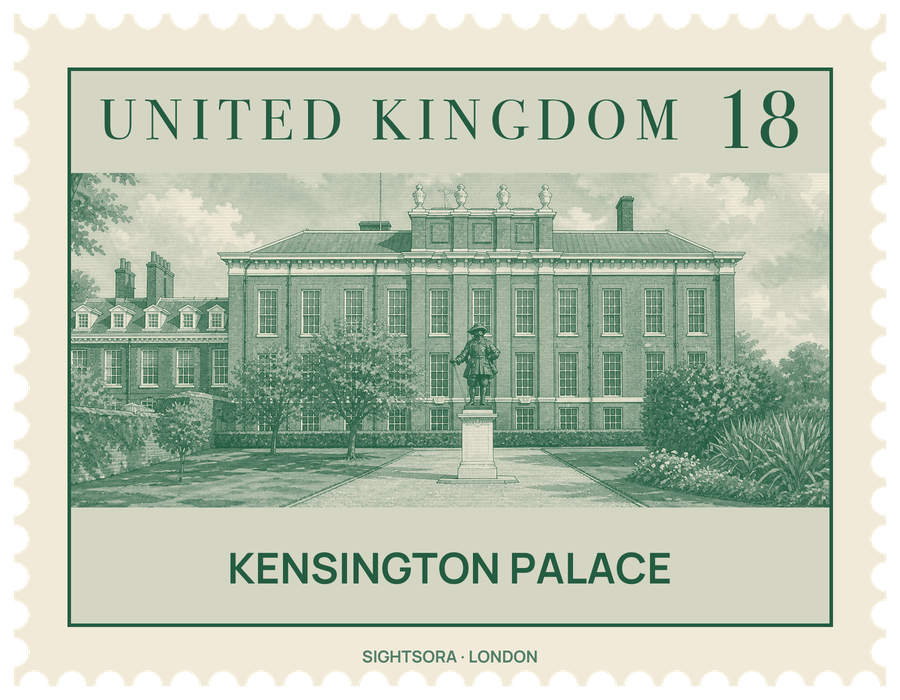
Its State Rooms are open to the public and cared for by the charity Historic Royal Palaces, while the rest of the building, with its apartments, cottages and offices, remains a private royal residence. Paintings and other objects from the Royal Collection hang in the public rooms.
The core was a two-storey Jacobean house built in 1605 in what was then the village of Kensington. In 1689 William III and Mary II bought it, wanting a home away from the damp air of Whitehall by the Thames that troubled the asthmatic king, and Sir Christopher Wren enlarged it with a three-storey pavilion at each corner and a courtyard entered beneath a clock tower. For the next seventy years it was the monarchs' preferred home. Mary died here in 1694, William in 1702, Queen Anne in 1714 and George II in 1760, after which only lesser members of the family lived here.
Visitors climb into the King's State Apartments by the King's Staircase, whose walls William Kent painted with a crowd of 45 figures from the court of George I, including two Turkish servants, Mahomet and Mustapha, and Peter 'the wild boy'. Kent also decorated the Cupola Room, its domed ceiling coffered in gold and blue and centred on the Garter star, while William III's own King's Gallery hangs Van Dyck's Charles I at the Hunt. The Queen's State Apartments, used by Mary II and later consorts, are deliberately plainer: a staircase of shallow steps, the Queen's Gallery of 1693 where Mary walked, read and sewed, a small dining room with 17th-century panelling, and a drawing room carved with William and Mary's linked monogram.
Queen Victoria was born here on 24 May 1819 and christened in the Cupola Room, and in 1837 she was woken to learn that she was queen and met the privy council for the first time in the Red Saloon, before moving to Buckingham Palace. Late in her reign the neglected State Rooms were saved from demolition at her insistence, restored with money from Parliament and opened to the public on her birthday in 1899. The palace's statue of Queen Victoria was sculpted by her daughter Princess Louise, who kept a studio in the palace.
In the 20th century the palace was home to Princess Margaret and later to Diana, Princess of Wales, whose sons William and Harry grew up here. After her death in 1997 the gates became the focus of public mourning, with more than a million bouquets laid in front of them and out into the gardens. Around the palace, the Orangery commissioned by Queen Anne in 1704 was designed by Hawksmoor and altered by Vanbrugh, and the royal gardener Charles Bridgeman reshaped Kensington Gardens for Queen Caroline, leaving the Round Pond, the Broad Walk and the Serpentine.
Getting there
The closest tube stations are Queensway, Bayswater and High Street Kensington; Gloucester Road is a little farther away.