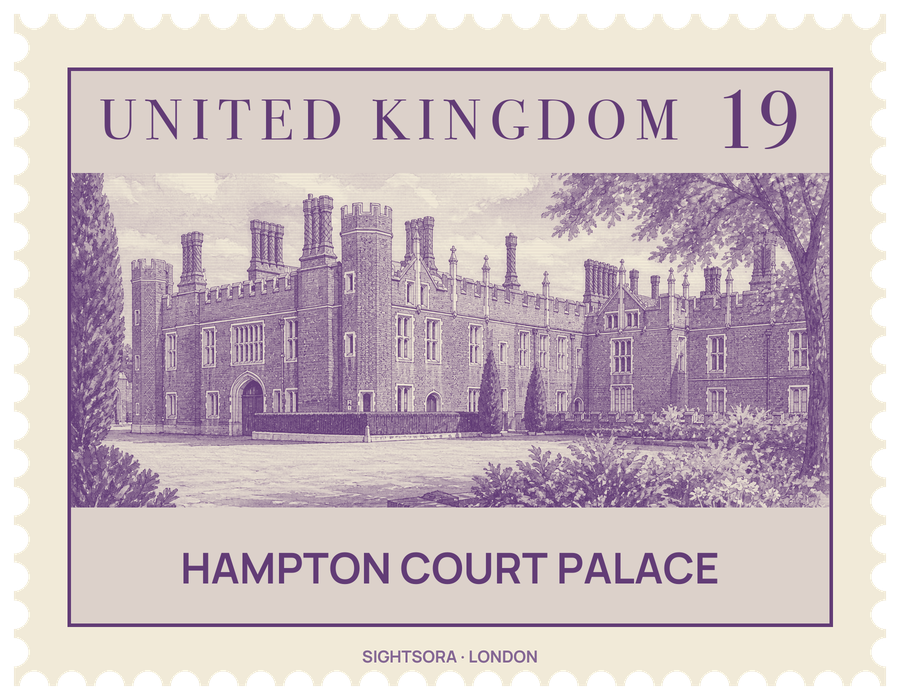
The palace and grounds are cared for by the charity Historic Royal Palaces, and the rooms display art and furniture from the Royal Collection.
Wolsey, Archbishop of York and chief minister to Henry VIII, took over the site in 1514 and built a Renaissance cardinal's palace, decorated by Italian craftsmen such as Giovanni da Maiano, whose relief busts of Roman emperors are set into the brickwork. In 1529, as he lost the king's favour, Wolsey gave the palace to Henry, who enlarged the kitchens to feed a court of over a thousand people and in the 1530s added the Great Hall under its carved hammerbeam roof, where he dined in state on a raised dais. In 1540 the inner gatehouse, known as Anne Boleyn's gate, received an astronomical clock that shows the hour, the moon's phases, the star sign and the time of high tide at London Bridge, once vital for anyone travelling by barge. Edward VI was born here in 1537, and Jane Seymour died here two weeks later.
From 1689 Sir Christopher Wren rebuilt half the Tudor palace in the manner of Versailles, around the Fountain Court, with two matching suites of state rooms: the King's looking south across the Privy Garden and the Queen's looking east. Pale Portland stone frames the pink brick, and round windows run along the upper floor. The King's Staircase is painted with murals by Antonio Verrio above ironwork by Jean Tijou, and the King's Guard Chamber is lined with muskets, swords and armour arranged in patterns on the walls. In the Lower Orangery hangs Andrea Mantegna's Triumphs of Caesar, the most important painting in the palace, and Mary II's blue-and-white porcelain is on show. George II was the last monarch to live here; the palace opened to the public in 1838, early in Queen Victoria's reign.
The palace chapel keeps its Tudor timber-and-plaster ceiling, the one piece of Tudor decoration Wren left there, above an oak reredos carved by Grinling Gibbons. On the bridge over the moat in front of the Great Gatehouse stand the King's Beasts, ten heraldic animals that trace the ancestry of Henry VIII and Jane Seymour. In Chapel Court, a Tudor-style garden laid out for the 500th anniversary of Henry's accession has painted wooden beasts on posts, flowers and herbs of the 16th century and green and white fences.
The grounds were laid out in the late 17th century, when three avenues fanning out from a semicircular parterre on the east front took their cue from Versailles; the central one is the Long Water, a canal dug in 1662. South of the palace is William III's Privy Garden, replanted in 1992 with clipped hollies and yews behind Tijou's gates. George London and Henry Wise planted the hedge maze for William III in the 1690s. Near the small riverside Banqueting House, a glasshouse shelters the Great Vine, about 100 feet (30 m) long, which still bears a crop of grapes every year, and Henry VIII's Royal Tennis Court stands in the grounds as well.