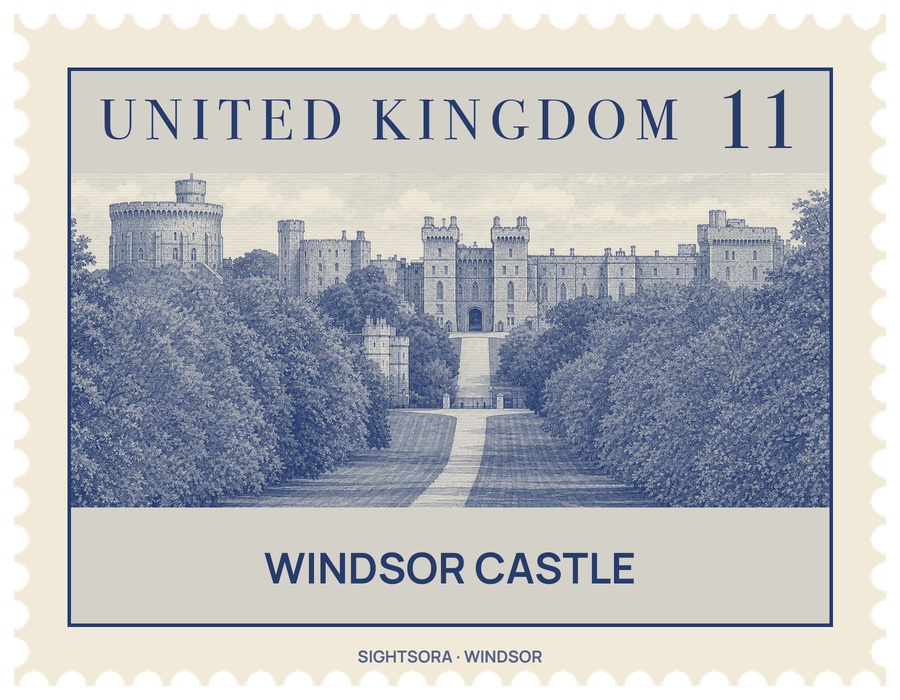
William the Conqueror founded it in the 11th century as a motte-and-bailey fortress guarding the river and the western approaches to London, and monarchs have used it since the reign of Henry I. Its 13 acres combine a fortress, a palace and a small town, and much of what visitors see today is a Georgian and Victorian reworking of medieval buildings. The castle is still a working royal residence and is open to visitors throughout the year.
The layout follows three wards around a central mound. On top of the 15-metre motte stands the Round Tower, a 12th-century keep that Jeffry Wyatville raised by about nine metres in the early 19th century to give the castle a grander skyline. To the east, the Upper Ward is a quadrangle with the State Apartments along its north side, an equestrian bronze of Charles II, cast in 1679, and the North Terrace looking out over the Thames.
The State Apartments take visitors through rooms in Classical, Gothic and Rococo styles, mostly designed by Wyatville for George IV. Three Baroque rooms from Charles II's time survive – the King's Dining Room and the Queen's Presence and Audience Chambers – with ceiling paintings by Antonio Verrio and carving by Grinling Gibbons. On 20 November 1992 a fire destroyed nine principal rooms and damaged more than 100 others; the restoration, completed in 1997, rebuilt St George's Hall under a new green-oak hammerbeam roof painted with the shields of the Knights of the Garter. A famous dolls' house was also made here for Queen Mary, designed by Edwin Lutyens and furnished by leading craftsmen of the 1930s, and the 14th-century undercroft now holds a café.
Below the Round Tower, the Lower Ward is dominated by St George's Chapel, a Perpendicular Gothic church of the late 15th and early 16th centuries where the Order of the Garter has its spiritual home and holds its yearly ceremony. Its carved choir stalls carry brass plates with the arms of six centuries of Garter knights, and ten kings are buried in the chapel; the vault before the altar holds Henry VIII, Jane Seymour and Charles I. Behind it, the Albert Memorial Chapel was decorated in marble, mosaic and bronze in memory of Prince Albert, and keeps its original ironwork door of 1246.
Beyond the walls, the Long Walk, an avenue of trees, runs straight for 4.26 kilometres south of the castle into Windsor Great Park, while Eton College lies about half a mile away across the river. The site is on a steep hill, with long walking distances and much of the visit outdoors.