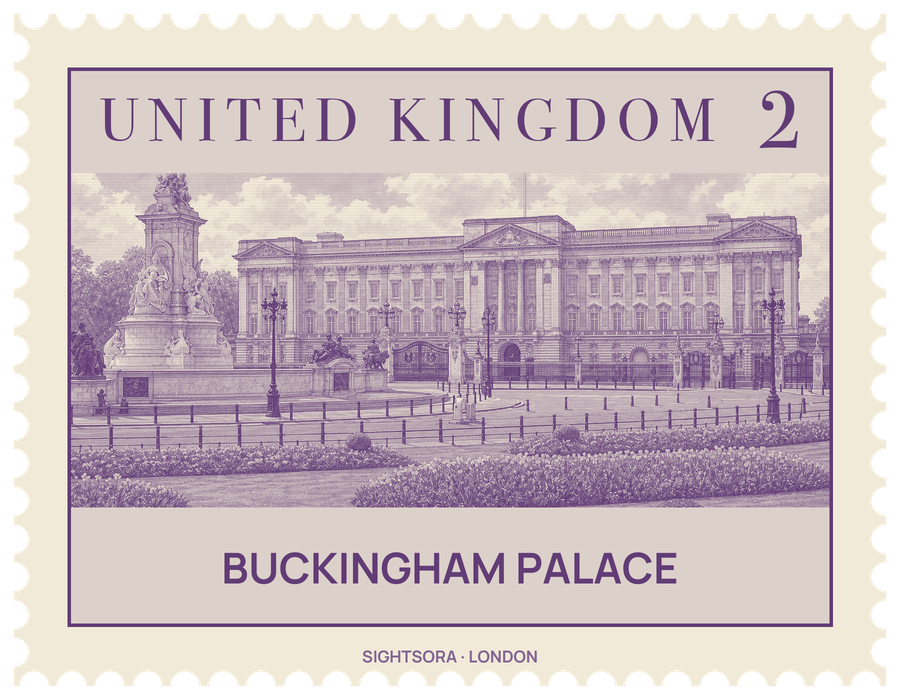
It is a working building as much as a landmark: state banquets, investitures, receptions and garden parties are held here, and the King meets the Prime Minister and newly arrived foreign ambassadors within its walls. The building has 775 rooms, among them 19 State Rooms, and the front measures 108 metres across.
The palace grew out of Buckingham House, a townhouse built in 1703 for the Duke of Buckingham and Normanby. George III bought it in 1761 for Queen Charlotte, and 14 of their 15 children were born there. In 1826 George IV and his architect John Nash began turning the house into a palace, doubling its size with new west-facing rooms faced in Bath stone; costs ran so high that Nash was dismissed, and Edward Blore completed the work. Queen Victoria was the first sovereign to live here, from July 1837. To give her family more space, Marble Arch was moved to the corner of Hyde Park and a fourth wing was built across the courtyard, creating the East Front that faces The Mall. In 1913 Sir Aston Webb refaced that front in Portland stone, the façade seen today.
The rooms that visitors see are the State Rooms on the first floor, behind the west-facing garden front, and they have changed little since Nash designed them. The Grand Staircase leads up to the Guard Room, with marble statues of Victoria and Albert in Roman dress, then on through the Green Drawing Room to the Throne Room, where investitures usually take place. At the centre of the suite runs the top-lit Picture Gallery, about 50 metres long, hung with works by Rembrandt, van Dyck, Rubens and Vermeer. The Music Room, whose great bow shapes the garden façade, is where several royal christenings have been held. State banquets are served in the Ballroom, built in 1854 and the biggest room in the palace.
The balcony on the East Front has been part of national celebrations since Queen Victoria first stepped onto it in 1851 for the opening of the Great Exhibition; royal appearances there have marked VE Day in 1945, jubilees and Trooping the Colour. The forecourt below, created in 1911 together with the memorial to Victoria outside the gates, is where Changing the Guard takes place. Notices of royal births and deaths are still fixed to the front railings for the public to read.
Next door, the Royal Mews, also by Nash, houses the royal carriages, among them the Gold State Coach, designed in 1760, along with the horses used in ceremonial processions. The King's Gallery, built on the site of the chapel destroyed by a German bomb in 1940, shows a changing selection of works from the Royal Collection. Behind the palace lies a 39-acre garden with more than 1,000 trees and a lake, the setting for the summer garden parties.