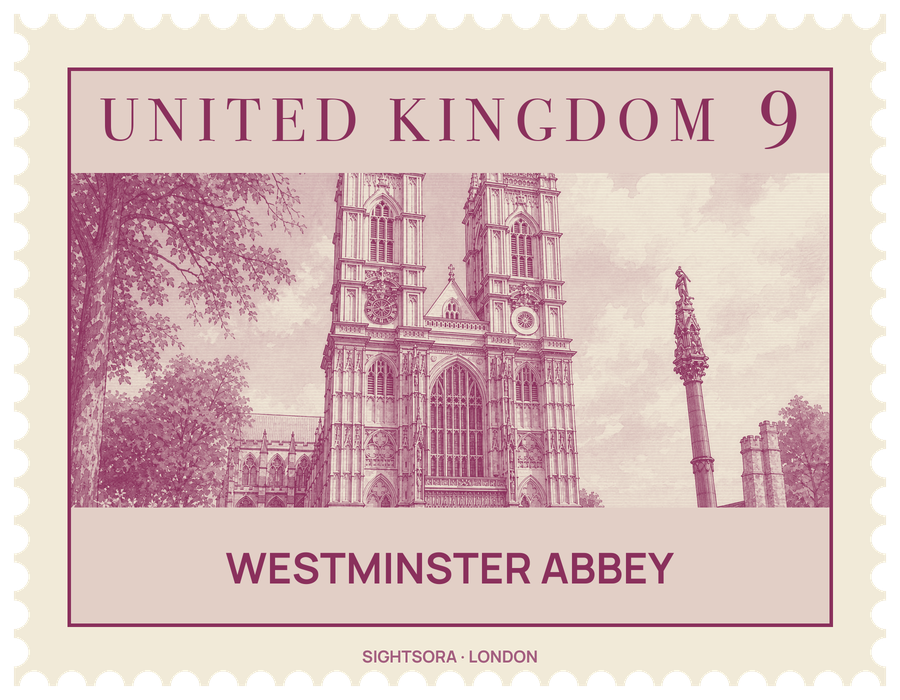
Some 18 monarchs are buried here, along with more than 3,300 people from every corner of national life, which led William Morris to call it a "National Valhalla". The abbey, the neighbouring Palace of Westminster and St Margaret's, the small church beside it, were inscribed together on the UNESCO World Heritage list in 1987. It remains a working church, and its services are open to everyone.
Benedictine monks were settled on what was then Thorney Island, an island in the Thames, around 959. Edward the Confessor rebuilt their church in the Romanesque style as his own burial place, and it was consecrated in December 1065, days before his death. The present building was begun in 1245 by Henry III, who modelled it on French cathedrals such as Reims, which is why the nave is tall and narrow, the east end is a rounded apse ringed by chapels, and flying buttresses support the walls. Work dragged on until the west window was finished in 1495, and the two western towers were added only in the 1740s by Nicholas Hawksmoor and John James.
Behind the high altar lies the shrine of Edward the Confessor, whose body, alone among the great English saints, was never removed from its shrine, surrounded by the tombs of medieval kings and queens among them Richard II, Edward III, Edward I, Henry III and, at the eastern end, Henry V. In front of the altar, at the crossing where coronations are staged, the Cosmati pavement has been laid for more than seven centuries: a floor pieced together from nearly 30,000 fragments of coloured stone and glass, made with stone and craftsmen that Abbot Richard Ware brought back from Rome. The Coronation Chair, used at coronations since the 14th century, is kept in a side chapel, St George's, by the west door.
At the far east end, the Henry VII Chapel, built from 1503, has a pendant ceiling carved to look like a fan vault, 95 statues of saints, and the banners of the Order of the Bath hanging over its stalls. Here are the tombs of Henry VII and Elizabeth of York, and in side chapels Elizabeth I, whose monument also holds the coffin of Mary I, and Mary, Queen of Scots. The south transept is Poets' Corner, where Geoffrey Chaucer was buried around 1400 and later writers such as Charles Dickens, Alfred, Lord Tennyson and Rudyard Kipling followed, with memorials to Shakespeare and Milton. Isaac Newton, Charles Darwin and Stephen Hawking lie close together in the nave.
Just inside the Great West Door is the grave of the Unknown Warrior, a soldier killed on a European battlefield in the First World War and buried on 11 November 1920; walking on this stone is forbidden, unlike any other grave slab in the floor. Above the door stand ten statues of 20th-century Christian martyrs, among them Martin Luther King Jr. and Dietrich Bonhoeffer. Beyond the church, the cloisters of the 13th and 14th centuries, the octagonal chapter house with its medieval tiled floor and wall paintings, and the Queen's Diamond Jubilee Galleries high up in the triforium, reached through the Weston Tower, are part of the visit; the galleries show life-size funeral effigies of monarchs. Security checks are carried out at the entrance.