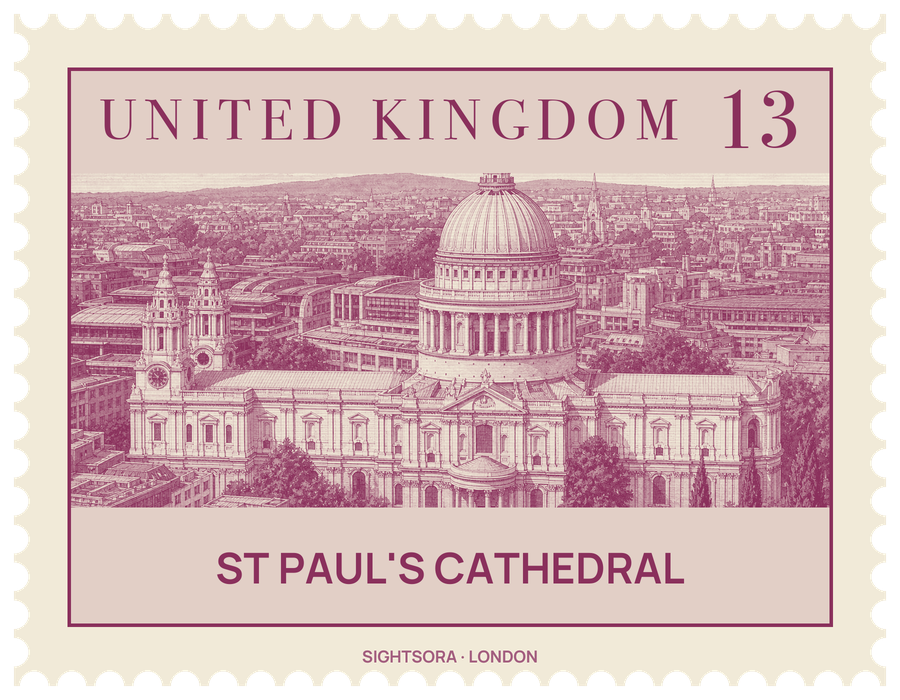
St Paul's is the cathedral of the Bishop of London, and a church dedicated to Paul the Apostle has stood on this site since AD 604. Its Gothic predecessor, Old St Paul's, was largely destroyed in the Great Fire of London in 1666; Wren was given the task of designing a replacement in 1669, the new church was consecrated on 2 December 1697, and the last stone was set on the lantern on 26 October 1708. Paid for by a tax on coal, it was finished within its architect's lifetime.
Wren mixed the long plan of English medieval cathedrals such as York and Winchester with ideas from Palladio, Inigo Jones, Baroque Rome and the buildings he had seen in France. The west front has a two-storey portico of paired columns between two towers, and the dome above the crossing was inspired by Michelangelo's at St Peter's in Rome, ringed by a continuous colonnade. Outside, the floral swags beneath the lower windows were carved by Grinling Gibbons.
Inside, the domed central space spans nave and aisles alike, and the dome's inner surface is painted by Sir James Thornhill with episodes from St Paul's life, eight in all. Climbing 259 steps leads to the Whispering Gallery, where a whisper against the wall can be heard on the far side of the gallery; higher still, outside, are the Stone Gallery and, beneath the lantern, the Golden Gallery. The choir is fitted with carvings by Gibbons and ironwork by Jean Tijou, and its vaults shine with mosaics by Sir William Blake Richmond. Behind the high altar, the apse is the American Memorial Chapel, dedicated in 1958, whose Roll of Honour lists more than 28,000 Americans who died while on their way to or based in Britain during the Second World War.
Look out too for Holman Hunt's version of The Light of the World in the south aisle, Henry Moore's Madonna and Child of 1943 in the north choir aisle, and the shrouded statue of the poet and dean John Donne, the only sculpture to come through the fire of 1666 intact. The largest monument is Alfred Stevens's memorial to the Duke of Wellington in the nave. In the crypt, among more than 200 memorials, Wellington and Nelson lie side by side, Nelson in a marble sarcophagus first made for Cardinal Wolsey, and Wren himself, buried there in 1723, is remembered by a Latin epitaph telling anyone in search of his monument to look about them.
Getting there
The closest Underground station is St Paul's, and the cathedral stands on St Paul's Churchyard.