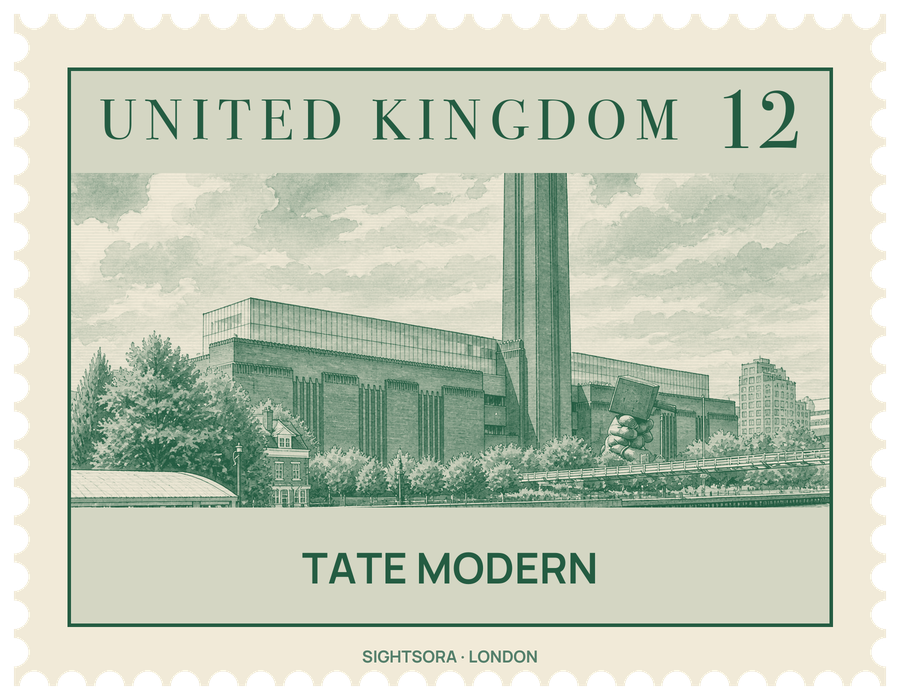
Sir Giles Gilbert Scott, who also designed Battersea Power Station, built it in two stages between 1947 and 1963, and it closed in 1981. After years under threat of demolition it was chosen as the new gallery's home in 1994; the architects Herzog & de Meuron converted it, adding a two-storey glass box along the roof, and the Queen opened it on 11 May 2000.
Visitors enter down a gentle ramp into the Turbine Hall, the vast space that once held the power station's generators and still has its overhead travelling crane. It runs the full length and height of the building, and its eastern end is tall enough for huge works: for part of every year it shows a large piece commissioned from a contemporary artist. Bridges cross the hall on levels 1 and 4, linking the two wings of the gallery.
North of the hall stands the Boiler House, whose galleries on levels 2, 3 and 4 cover the whole period since 1900; each floor is split into large east and west wings. The collection is hung by theme rather than in date order, with some rooms changing periodically; a three-room Start Display introduces the basic ideas of modern art, and there is an area for the Artist Rooms collection.
To the south, the Blavatnik Building, also by Herzog & de Meuron and opened on 17 June 2016, is a ten-storey tower with a sloping skin of brick latticework that echoes the old power station. It shows art from 1960 onwards. At its base, level 0, are the Tanks, three circular underground oil tanks from the power station reused for live performance, installation and video art.
Getting there
Blackfriars, a mainline and Underground station, is the closest, about 0.5 km away through its south entrance. Southwark Underground station is also nearby, and orange lampposts mark the route from its exit to the gallery. From north of the river, St Paul's and Mansion House stations connect via the Millennium Bridge. Riverboats call at Bankside Pier outside the gallery, including the Tate to Tate service to Tate Britain and services to the Docklands and Greenwich.