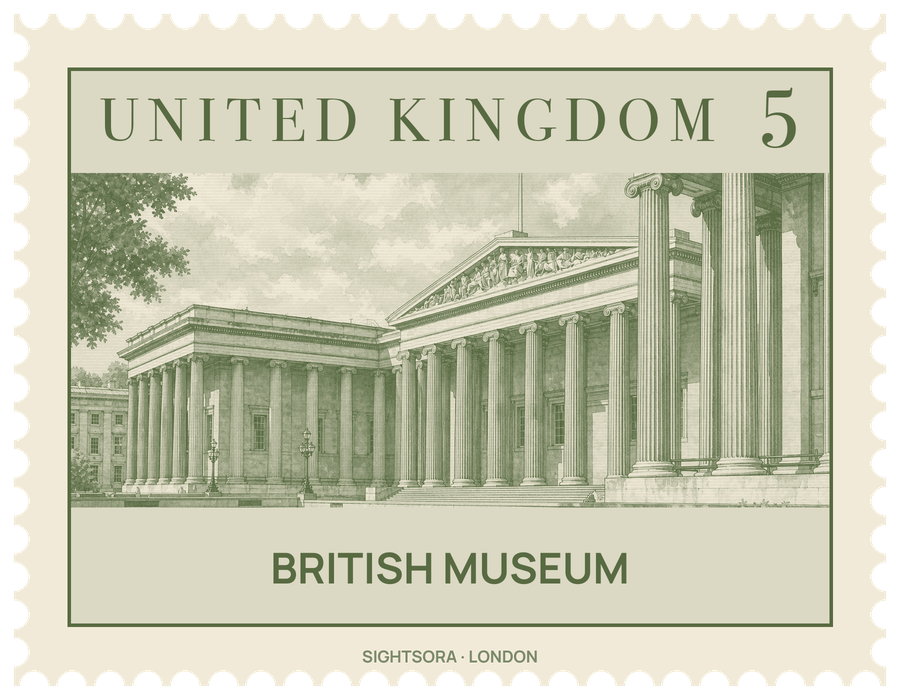
It was founded by Act of Parliament in 1753 and opened to visitors in 1759, as a national museum that belonged to neither church nor crown and was open to the public. The starting point was the collection of the physician Sir Hans Sloane, some 71,000 objects that he left to the nation in return for a payment to his heirs. The museum's growth over the following 250 years came largely through British colonial expansion, and several of its best-known pieces, among them the Elgin Marbles and the Rosetta Stone, are the subject of long-running claims for their return.
The present building is the Greek Revival work of Sir Robert Smirke, built wing by wing around a central courtyard between 1823 and 1847; the pediment over the entrance carries fifteen allegorical figures by Sir Richard Westmacott showing The Progress of Civilisation. In the middle of that courtyard stands the Round Reading Room, designed by Sydney Smirke and opened in 1857, where researchers consulted the museum's library for almost 150 years. When the British Library moved to St Pancras, the space around it was covered with a glass and steel roof of 1,656 individually shaped panes, designed by Foster and Partners; this Queen Elizabeth II Great Court opened in 2000 and is now the hub from which the galleries are reached.
Nearly one hundred galleries are open to the public, and the Egyptian collection, with more than 100,000 objects from the Nile Valley, is among the broadest. The Rosetta Stone came to the museum in 1803 among the antiquities taken from the French after the Battle of the Nile, and Room 4 is given over to monumental Egyptian sculpture. Upstairs, the second-floor galleries show a selection from the museum's 140 mummies and coffins.
The Greek and Roman galleries hold sculpture from the Parthenon in Athens, displayed in the Duveen Gallery, as well as a Caryatid from the Erechtheion and fragments from Halicarnassus's great Mausoleum and from Ephesus's Temple of Artemis, two monuments that ancient writers listed among the Seven Wonders. The Roman cameo-glass Portland Vase is here too. From ancient Iraq come whole rooms lined with alabaster reliefs from the Assyrian palaces of Nimrud and Nineveh, including the Lion Hunt of Ashurbanipal, along with the winged lamassu guardians and the Black Obelisk of Shalmaneser III. Treasures from the royal tombs of Ur, such as the Standard of Ur and the Ram in a Thicket, and the Cyrus Cylinder from Babylon complete the Middle East collections.
Further on, the finds from the Sutton Hoo royal burial, donated by Edith Pretty, on whose land the grave lay, are the highlight of early medieval Britain and Europe, and the national collection of clocks and watches traces the history of timekeeping. The Sainsbury African Galleries display 600 objects, and the African collection includes the Benin Bronzes, taken in 1897, and the bronze head of Queen Idia, while Gallery 33 brings together Chinese, South Asian and South-east Asian art. Even so, only about 50,000 items, less than 1% of everything the museum holds, are on show at any time.