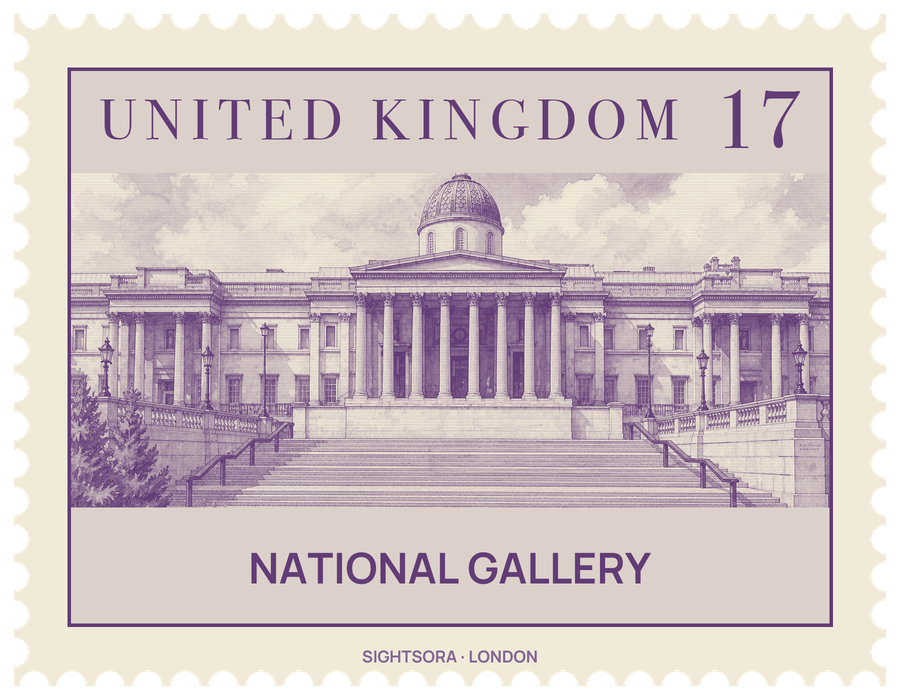
Its scope is wide rather than huge: the main turns of Western painting from Giotto to Cézanne each have important works here, which makes it a place to follow European art in sequence, room by room.
Unlike the great galleries of continental Europe, it did not grow out of a royal collection. The British government founded it in 1824 by buying 38 paintings that had belonged to the banker John Julius Angerstein, and first showed them in his former townhouse at No. 100 Pall Mall. Gifts from private collectors have since supplied two-thirds of the holdings, while early directors, above all Sir Charles Lock Eastlake, went abroad to buy Early Italian and Northern Renaissance pictures. In 1897 British art by later artists was moved to what became the Tate Gallery, and since 1996 the year 1900 has marked the end point of the collection.
The building on the square was designed by William Wilkins, begun in 1832 and opened in 1838. It was mocked from the start, and only the façade facing the square survives largely as it was; behind it the gallery grew in stages, including E. M. Barry's grand rooms of 1872–1876, laid out on a Greek cross around a central octagon. In the entrance hall, the landing floors carry mosaics by Boris Anrep, laid between 1928 and 1952, whose allegorical figures include portraits of Winston Churchill, Virginia Woolf, Bertrand Russell and T. S. Eliot. To the west, the Sainsbury Wing of 1991 by Robert Venturi and Denise Scott Brown houses the Renaissance paintings in quieter, top-lit rooms finished in grey pietra serena, where columns shrink step by step along the main axis to make the long vista look deeper.
Among the works visitors come to see are Jan van Eyck's Arnolfini Portrait, Piero della Francesca's Baptism of Christ, Botticelli's Venus and Mars and Leonardo da Vinci's Virgin of the Rocks, along with his large drawn cartoon in which Saint Anne and Saint John the Baptist join the Virgin and Child. Holbein's The Ambassadors, Titian's Bacchus and Ariadne, Velázquez's Rokeby Venus and Vermeer's two ladies at a virginal belong to the same collection. The British rooms include Constable's The Hay Wain, Turner's The Fighting Temeraire, Stubbs's Whistlejacket and Gainsborough's Mr and Mrs Andrews, and the later pictures end with Monet, Seurat's Bathers at Asnières and Van Gogh's Sunflowers.
Some of these paintings carry stories of their own. During the Second World War the collection was hidden in a slate quarry at Manod in North Wales, and Myra Hess and other musicians gave lunchtime concerts in the empty building; the gallery's Picture of the Month began then, when one painting at a time was brought back to London for the public. In 1961 a portrait of the Duke of Wellington by Goya was stolen from the gallery and returned voluntarily four years later.