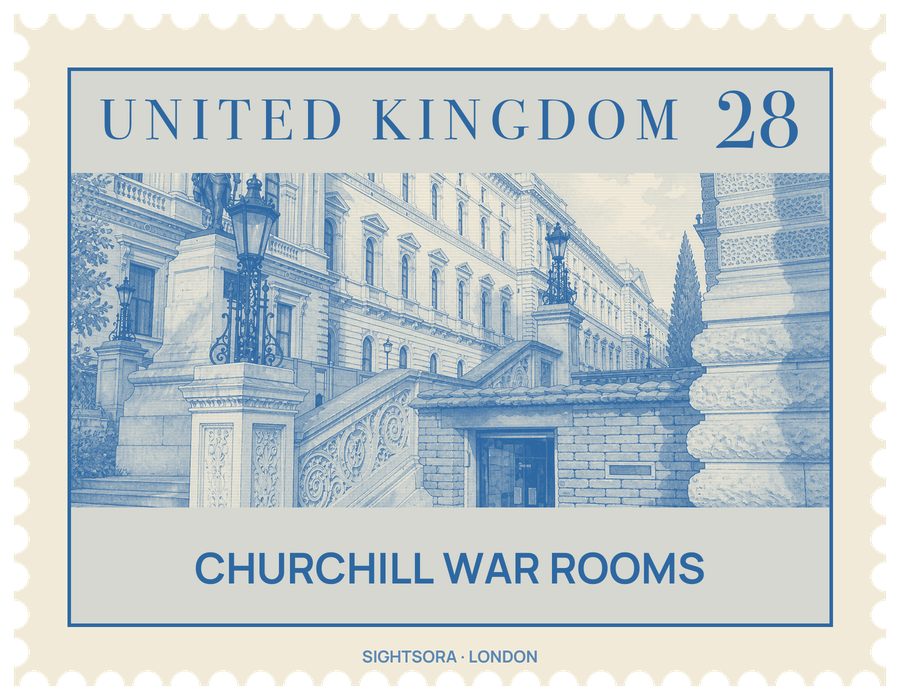
Run by the Imperial War Museum as one of its five branches, the site combines the Cabinet War Rooms themselves with the Churchill Museum, a museum devoted to Winston Churchill's life. Since 2012 visitors have entered through a faceted bronze entranceway.
Work on turning the basement of what were then the New Public Offices into an emergency government centre began in June 1938, when it was feared that bombing would devastate central London. Because the rooms lie below the level of the Thames, flood doors and pumps were fitted along with ventilation, soundproofing and broadcasting equipment, and the complex came into use on 27 August 1939, a week before Britain declared war on Germany. During the Blitz a concrete layer up to 1.5 metres thick, known as the Slab, was laid over it, and by spring 1941 the rooms had grown to three times their first size.
Visitors see the rooms where the war was directed. In the Cabinet Room the prime minister met the chiefs of the army, navy and air force; after taking office in May 1940, Churchill declared that this was the room from which he would run the war, and in all 115 Cabinet meetings took place in the War Rooms, ending on 28 March 1945. The Map Room was staffed day and night by officers of all three services, who prepared a daily intelligence summary for the King, the prime minister and the Chiefs of Staff. Churchill's office-bedroom held BBC equipment for his wartime broadcasts, although he rarely slept below ground; from 1943 an encrypted line, later extended to the purpose-built Transatlantic Telephone Room, let him speak securely with President Roosevelt in Washington.
When Japan surrendered on 15 August 1945, the staff simply switched off the Map Room lights the next day and left, and four rooms were kept for their historic value: the Cabinet Room, the Map Room, Churchill's bedroom and the Transatlantic Telephone Room. Margaret Thatcher opened them to the public on 4 April 1984. Rooms used by Churchill, his wife and close associates were restored and added in 2003, and in 2005 the Churchill Museum opened, arranged around a 15-metre interactive table that gives access to digitised material from the Churchill Archives Centre.